What Are Solar Panels Made Of? Materials, Layers and Buying Tips
Article Body
What Are Solar Panels Made of silicon solar cells sealed between tempered glass and a polymer backsheet or second glass layer, with an aluminum frame, copper and silver conductors, and a junction box with bypass diodes.
That one sentence covers most panels on the market. The detail underneath it decides how long a panel lasts, how well it handles heat, and whether it is worth its price.
This guide walks through each material, how the pieces are made and assembled, and what to check before you buy, whether you are fitting a home roof or specifying a commercial array.
What Is Inside a What Are Solar Panels Made Solar Panel?
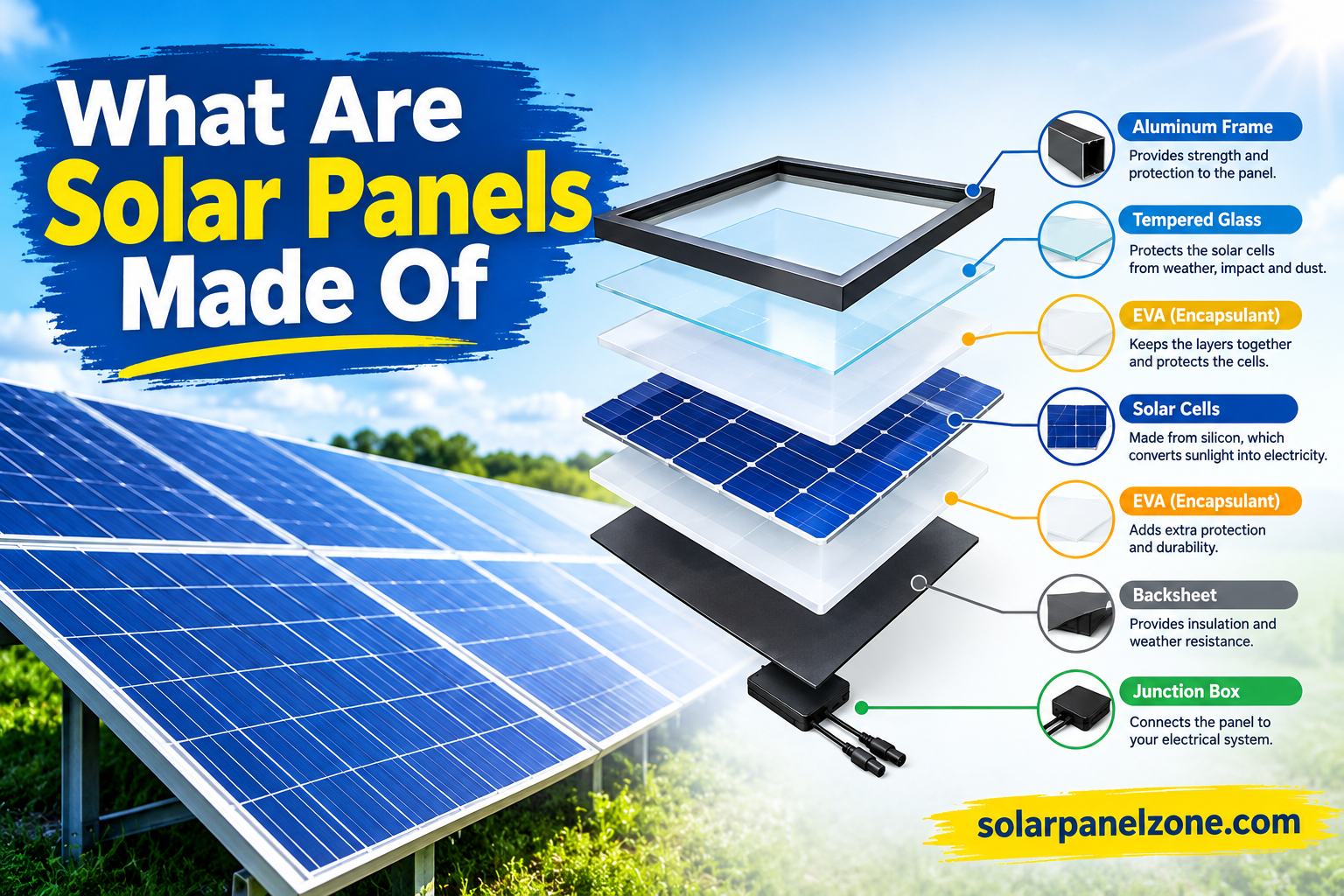
A What Are Solar Panels Made solar panel, also called a photovoltaic (PV) module, works like a sandwich. Every layer has one job: let light in, turn it into current, carry that current out, or protect the cells for decades.
From sun side to back, the stack looks like this:
- Front glass
- Encapsulant film
- Silicon cells joined by metal ribbons
- Encapsulant film
- Backsheet or rear glass
- Aluminum frame around the edge, with a junction box on the back
Solar cells: where the electricity is made
The cell is the active part of the panel. In most What Are Solar Panels Made panels it is a thin wafer of crystalline silicon, roughly the thickness of a few human hairs.
Silicon is a semiconductor. Adding small amounts of boron or phosphorus creates a p-n junction, the electrical boundary where sunlight knocks electrons loose and pushes them into a current. This is the photovoltaic effect.
A thin silicon nitride coating sits on top. It cuts reflection and gives cells their deep blue or black look.
Tempered glass: the shield
The front layer is low-iron tempered glass, usually around 3 mm thick in standard framed panels. Low iron means it lets more sunlight through. Tempering makes it far tougher against hail, wind and impact.
Many What Are Solar Panels Made panels add an anti-reflective coating to squeeze out a little more light.
Encapsulant: the glue that seals everything
Two clear polymer films wrap the cells. The traditional choice is EVA (ethylene vinyl acetate). POE (polyolefin elastomer) is increasingly used because it resists moisture better, especially with newer n-type cells.
During lamination the films melt and bond the glass, cells and back layer into one sealed unit.
Backsheet or rear glass: the back-side protection
Polymer backsheets are typically built from materials such as PET, PVF, PVDF or polyamide. They insulate the cells electrically and keep out moisture.
In glass-glass panels, a second sheet of glass replaces the backsheet. More on that trade-off below.
Metal contacts and wiring
Three metals do the conducting:
- Silver paste is printed on the cell surface as fine lines (fingers and busbars) that collect electrons.
- Copper ribbons and cables link cells and carry current to the connectors.
- Tin-based solder, which in some panels contains lead, joins the ribbons to the cells.
Aluminum frame
Anodized aluminum gives the panel rigidity and mounting points. It is light, resists corrosion and is easy to recycle.
Junction box, bypass diodes and connectors
A sealed plastic box on the rear holds bypass diodes. These let current route around shaded or damaged cells so one shadow does not shut down the whole panel.
Cables with MC4-type connectors link What Are Solar Panels Made panels into strings.
What Are Solar Panels Made Percentage of a Solar Panel Is Each Material?
By weight,What Are Solar Panels Made a solar panel is mostly glass and metal, not silicon. These are approximate shares for a standard framed crystalline-silicon module, in line with lifecycle analyses such as those from the Institute for Sustainable Futures. Exact figures vary by manufacturer, so always check a specific datasheet.
| Component | Material | Approx. share of weight | Function |
|---|---|---|---|
| Front glass | Tempered low-iron glass | About three-quarters | Protection and light transmission |
| Frame | Anodized aluminum | Roughly 8–10% | Structure and mounting |
| Encapsulant, backsheet, junction box | EVA or POE, PET or PVDF, plastics | Roughly 10% | Sealing and insulation |
| Cells | Crystalline silicon | Roughly 3–5% | Converts light to electricity |
| Conductors | Copper, silver, tin (and sometimes lead) | Around 1–2% combined | Carry current out |
Silicon is a small slice of the weight but nearly all of the function. Glass is the bulk but the cell is the brain.
Which Material Matters Most?
For power generation, silicon. For longevity, glass and the encapsulant. For cost swings, silver and polysilicon.
What Are Solar Panels Made panel with excellent cells and a weak backsheet can lose output or fail early. Quality shows up in how well the materials work together, not in any single ingredient.
What Are Solar Panels Made Solar Panels Are Made
Manufacturing runs from sand to a finished module in a sequence of tightly controlled steps.
- Refine silica. Quartz is reduced to metallurgical-grade silicon in an arc furnace.
- Purify to polysilicon. Chemical processes such as the Siemens process raise purity to solar grade, commonly 99.9999% or higher.
- Grow crystals. Monocrystalline ingots are typically pulled using the Czochralski method. Polycrystalline silicon is cast in blocks.
- Slice wafers. Diamond-wire saws cut ingots into very thin wafers.
- Build cells. Wafers are textured, doped, coated with an anti-reflective layer and printed with metal contacts.
- String and laminate. Cells are soldered into strings, laid between encapsulant films, glass and backsheet, then heat-pressed.
- Frame and wire. The aluminum frame goes on, followed by the junction box and cables.
- Test. Flash testing, electroluminescence imaging and insulation checks catch defects before shipping.
Most of the world’s polysilicon, wafer, cell and module capacity is concentrated in China, with growing capacity in India, Southeast Asia, the US and Europe (source: IEA PVPS reports; check the latest edition for current shares).
Types What Are Solar Panels Made of Solar Panels by Cell Material
Crystalline silicon dominates, but it is not the only option.
| Type | Core material | Typical efficiency | Where it fits |
|---|---|---|---|
| Monocrystalline silicon | Single-crystal silicon | About 20–24% | Homes, businesses, most new projects |
| Polycrystalline silicon | Multi-crystal silicon | About 15–18% | Older or budget systems; now rare in new products |
| Thin-film CdTe | Cadmium telluride | About 16–19% | Utility-scale (First Solar is the main producer) |
| Thin-film CIGS | Copper indium gallium selenide | About 13–17% | Lightweight or flexible uses |
| Amorphous silicon | Non-crystalline silicon | Roughly 6–10% | Small devices and niche products |
| Perovskite and tandem cells | Perovskite layers, often on silicon | Lab and early-commercial | Emerging; durability is still being proven |
Efficiency ranges are approximate (sources: NREL research-cell data and manufacturer datasheets). Lab tandem cells have passed 30%, but commercial products are still being validated for long-term reliability.
Why are some What Are Solar Panels Made solar panels blue and others black?
Polycrystalline cells look blue because of the many crystal grains and the anti-reflective coating. Monocrystalline cells have a uniform crystal that reflects less, so they appear dark blue to black. Black backsheets and frames deepen the effect.
Color does not tell you quality, only cell type and styling.
Modern cell designs worth knowing
The cell layout matters as much as the crystal type. These names show up on datasheets:
- PERC: adds a rear passivation layer to cut losses. Mature and widely available.
- TOPCon (n-type): uses a thin tunnel oxide and doped layer. Offers strong heat performance and low degradation.
- HJT (heterojunction): stacks thin amorphous silicon on a crystalline wafer. High efficiency and good behavior in hot weather.
- Back-contact: places all metal on the rear for a cleaner front and higher efficiency.
n-type cells use phosphorus-doped silicon, while older p-type cells use boron. n-type designs generally degrade less in the first year, which is why most major makers have shifted toward them.
Glass-Glass vs Backsheet Panels
This is one of the most important construction choices, and one that many beginner guides skip.
| Feature | Glass-backsheet | Glass-glass |
|---|---|---|
| Rear layer | Polymer film | Second glass sheet |
| Weight | Lighter | Heavier |
| Moisture protection | Good | Excellent |
| Bifacial (rear-side) gain | Limited | Common |
| Typical warranty | Often 12–25 years product | Often longer product warranties |
| Main risk | Polymer cracking or yellowing in some older designs | Handling and mounting weight |
Backsheet failures have been documented in the field, so the specific polymer matters, not just the label. For coastal, humid, desert or high-voltage utility sites, glass-glass is often the safer long-term pick.
For a standard home roof, a quality backsheet panel from a bankable brand is perfectly reasonable.
Are Solar Panels Toxic?
Intact silicon panels pose little risk in normal use. The materials are mostly glass, aluminum, silicon and plastics.
Two points deserve honesty:
- Lead: some What Are Solar Panels Made panels use lead-containing solder. Photovoltaic panels fall outside the scope of the EU RoHS directive, so lead-free solder is a choice rather than a requirement. Many manufacturers now offer lead-free options, so check the datasheet.
- Cadmium: CdTe thin-film panels contain cadmium telluride sealed inside glass. Risk is low while panels are intact, and producers such as First Solar run take-back and recycling programs.
The practical safety warnings are different. Never cut, drill or step on a panel. A cracked What Are Solar Panels Made panel in sunlight can still produce live voltage, and wiring should always be done by a qualified electrician.
Supply Chain, Silver and Carbon Footprint
Serious buyers, especially commercial ones, now ask where materials come from.
- Polysilicon: purification is energy-intensive, so What Are Solar Panels Made a panel’s carbon footprint depends heavily on the electricity used to make it. What Are Solar Panels Made What Are Solar Panels Made Panels made with lower-carbon power have a smaller footprint. Energy payback time (how long a panel takes to generate the energy used to make it) is commonly estimated at roughly one to two years.
- Forced-labor concerns: reports about parts of the polysilicon supply chain have led to import controls such as the US Uyghur Forced Labor Prevention Act. Business buyers increasingly request traceability documents.
- Silver: it is a small share of weight but a large share of cell cost. Manufacturers are cutting silver per cell and exploring copper metallization.
- Copper and aluminum: well-established recycling streams reduce long-term supply pressure.
Standards and Datasheet Checks
A datasheet tells you What Are Solar Panels Made panel is really made of and how it was tested. Look for:
- IEC 61215: design qualification for crystalline panels.
- IEC 61730: electrical and fire safety construction.
- UL 61730: the North American safety listing.
- IEC 61701: salt mist corrosion, relevant near coastlines.
- IEC 62716: ammonia corrosion, relevant near farms.
- Independent reliability data: reports such as the Kiwa PVEL scorecard help compare manufacturers beyond their own claims.
Also compare efficiency, temperature coefficient (how much output drops as heat rises), annual degradation (commonly about 0.4–0.6% per year, so check each datasheet) and the length of both the product and performance warranties.
What Are Solar Panels MadeDoes 720k Mean for a Solar System?
There is no solar panel specification called “720k.” The most sensible reading is a 720 kW system, which is 720,000 watts.
Here is a simple illustration, not a quote:
- With 550 W panels, 720,000 ÷ 550 comes to roughly 1,310 panels.
- At about 2.6 square meters each, that is around 3,400 square meters of module area, before walkways and spacing.
- At about 28 kg per panel, the modules weigh roughly 37 tonnes, most of it glass.
At this scale the materials list gets longer. A commercial project also needs racking, cabling, inverters and sometimes battery storage (lithium iron phosphate is a common chemistry). Procurement teams should request a bill of materials and an end-of-life plan, since both affect cost and ESG reporting.
How to Choose the Right Construction
Work through these questions in order:
- How much space do you have? Tight roof: pick high-efficiency monocrystalline (TOPCon, HJT or back-contact). Large site: cost per watt may matter more than efficiency.
- How hot is it? Check the temperature coefficient and consider n-type cells.
- Is the environment harsh? Coastal, dusty, humid or high-hail areas favor glass-glass with POE encapsulant and corrosion certifications.
- Is weight limited? Choose lighter backsheet panels, or flexible modules if you accept shorter lifespans.
- Who stands behind it? Compare warranty terms and the manufacturer’s financial strength. Established names include LONGi, JinkoSolar, Trina What Are Solar Panels Made Solar, JA Solar, Canadian Solar and First Solar.
When comparing quotes, use price per watt and total system cost rather than the What Are Solar Panels Made panel price alone.
Recycling and End of Life
What Are Solar Panels Made a panel can be recovered. Glass and aluminum are recycled routinely. Silicon, silver and copper can be recovered through specialized processes that are still scaling up.
The EU WEEE Directive requires producers to fund collection and recycling of PV panels. Other regions are developing similar rules, and manufacturer take-back programs exist for some products.
Plan for disposal at purchase time. Ask your supplier or installer what recycling route is available locally.
Common Mistakes to Avoid
- Buying on watts alone and ignoring degradation and temperature behavior.
- Skipping certification paperwork.
- Choosing the cheapest backsheet panel for a harsh environment.
- Assuming all frames and encapsulants are equal.
- Treating a damaged panel as safe because it looks dull or cracked.
- Attempting DIY wiring without proper training.
Frequently Asked Questions
What Are Solar Panels Made are solar panels?
Tempered glass, silicon cells, polymer encapsulant, a backsheet or second glass layer, an aluminum frame, copper and silver conductors, and a junction box with diodes. By weight, glass is the largest share and silicon the smallest of the main materials.
What Are Solar Panels Made solar panels made of silicon?
Most are. Crystalline silicon accounts for the large majority of panels sold today. Thin-film types use materials such as cadmium telluride or CIGS instead.
What Are Solar Panels Made is the most important material in a solar panel?
The semiconductor cell, usually silicon, because it creates the electricity. Glass and encapsulant matter just as much for durability.
What Are Solar Panels Made metals are in solar panels?
Aluminum in the frame, copper in wiring and ribbons, silver in cell contacts, and tin or sometimes lead in solder. Thin-film types may also use cadmium, tellurium, indium, gallium or selenium.
What Are Solar Panels Made solar panels toxic or bad for the environment?
In normal use they are low-risk. Concerns center on small amounts of lead in some solder, cadmium in CdTe panels, and manufacturing emissions. Recycling and low-carbon production reduce the impact.
Can solar panels be recycled?
Yes. Glass and aluminum are recycled easily, and recovery of silicon, silver and copper is improving. Availability depends on regional infrastructure and regulation.
How long do solar panels last?
Many carry performance warranties of 25 to 30 years and keep producing beyond that at reduced output. Real life depends on construction quality, climate and installation.
What does 720k mean for solar panels?
It is not a standard panel specification. It most likely refers to a 720 kW system, which needs roughly 1,300 panels of 550 W each.
What Are Solar Panels Made is inside a solar panel?
A stack of front glass, encapsulant, silicon cells, more encapsulant and a rear layer, framed in aluminum with a junction box on the back.
Conclusion
What Are Solar Panels Made What Are Solar Panels Made solar panel is a carefully engineered laminate. Glass protects, silicon generates, polymers seal, aluminum supports, and silver and copper carry the current.
When you compare options, look past the wattage. Check the cell type, rear layer, certifications, degradation rate and warranty. Match the construction to your climate and site, and ask about recycling before you sign.
For a home, a well-certified monocrystalline panel from a bankable brand covers most needs. For harsh sites or commercial and utility projects, glass-glass construction and a full bill of materials are worth the extra scrutiny.
These information about solar panel mounting are gathered from different surveys, medical tests and tech giants like Tom’s Guide and more. Our top priority is to provide you valuable information.
For More Details About Different Solar Panels Click Here