400W Solar Panels: What They Produce, What They Cost, and What 720k Really Means
A 400W solar panel typically produces about 1.2 to 2.4 kWh per day, depending on sun hours, heat and system losses. Most real-world setups land near 1.5 kWh. Prices range from roughly $160 to $560 per panel, depending on quality, region and what is included.
That is the short version. The rest of this guide explains why the numbers vary so much, how to size a system around a 400W Solar Panels module, and how to read a “720k” target, whether you mean 720 kWh or a 720,000 budget in your local currency.
What does “720k” mean in a solar search?
People use the number in two main ways, and both are covered below.
- 720 kWh: a monthly or yearly energy target. This is the most common global reading.
- A 720,000 budget: common in markets that price in rupees and similar currencies, where buyers want to know what that sum buys.
If you are working from a kWh figure, jump to the sizing section. If you are working from a budget, jump to the budget section.
What is a 400W solar panel?
A 400W Solar Panels is a photovoltaic module rated to deliver 400W Solar Panels watts under Standard Test Conditions (STC): 1,000 W/m² of sunlight at a cell temperature of 25°C. Your roof is rarely that perfect, so real output is lower.
Most 400W Solar Panels modules use monocrystalline silicon, often with half-cut cells and PERC or TOPCon cell technology. Many use 144 half-cut cells in a size similar to older 72-cell 400W Solar Panels. Typical dimensions are about 1.7 to 2.0 m², and weight is usually in the 20 to 25 kg range. Always confirm on the datasheet.
Major manufacturers such as LONGi, JinkoSolar, Trina 400W Solar Panels, Canadian Solar and JA 400W Solar Panels publish datasheets for this class. Newer lines skew toward higher wattages, so 400W Solar Panels often appears in compact or older-format ranges.
Key specs to read on the datasheet
- Vmp and Imp: the voltage and current at maximum power. One guide quotes about 8 to 9 amps at roughly 45 V. Many 400W Solar Panels modules sit closer to 9 to 10 amps, so check yours.
- Voc and Isc: open-circuit voltage and short-circuit current, used for string sizing.
- Temperature coefficient: how much power drops as cells heat up.
- Efficiency: the share of sunlight converted to power.
- Warranty: both product and performance terms.
How much does a 400W solar panel produce?
The math is simple. Energy equals power times time. At 5 peak sun hours, a 400W Solar Panels panel gives 0.4 kW × 5 h = 2.0 kWh per day on paper.
Real systems lose energy to heat, dust, wiring, inverter conversion and mismatch. A common planning shortcut multiplies by about 75%.
Why sources disagree
Online guides quote anything from 1.2 to 3 kWh per day. The gap comes from different sun hours and different assumptions about losses. This table reconciles them.
| Peak sun hours | On-paper output | Realistic output (~75%) |
|---|---|---|
| 3 | 1.2 kWh | 0.9 kWh |
| 4 | 1.6 kWh | 1.2 kWh |
| 5 | 2.0 kWh | 1.5 kWh |
| 6 | 2.4 kWh | 1.8 kWh |
| 7 | 2.8 kWh | 2.1 kWh |
For a realistic day, 1.2 to 2.0 kWh covers most locations. Figures above 2.4 kWh need very strong sun and good conditions.
Monthly and yearly output
At a realistic 1.5 kWh per day, one 400W Solar Panels produces about 45 kWh per month and about 550 kWh per year. A cloudier site at 1.2 kWh per day gives roughly 440 kWh per year.
To check your own site, use PVWatts, PVGIS or Global Solar Atlas. They estimate yield from your location, tilt and orientation.
Summer, winter and heat
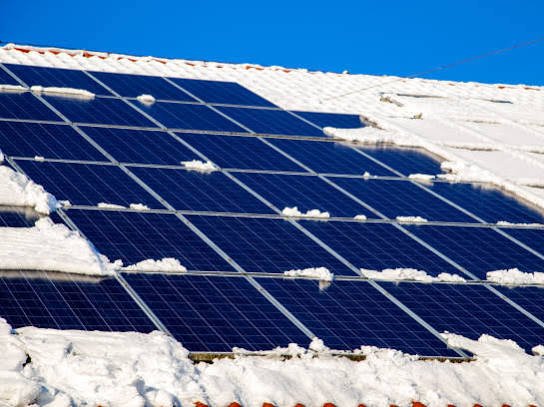
Output swings with the seasons. Winter days are shorter and the sun sits lower, so production can fall well below the yearly average. Summer gives more hours but also more heat.
400W Solar Panels lose power as they warm. Many modules lose roughly 0.3 to 0.35% of power for each degree Celsius above 25°C. A cell running at 60°C could lose around 10 to 12% from heat alone. Hot-climate buyers should compare temperature coefficients, not just wattage.
What can a 400W solar panel run?
400W Solar Panels make energy during daylight, so the question is how much energy your devices use.
| Device | Typical draw | Rough daily energy |
|---|---|---|
| LED lights (5 bulbs, 5 h) | 50 W | 0.25 kWh |
| Laptop (8 h) | 60 W | 0.5 kWh |
| Ceiling fan (8 h) | 60 W | 0.5 kWh |
| Efficient fridge | varies | about 1 kWh or more |
| Air conditioner | 1–1.5 kW while running | about 1–1.5 kWh per hour |
One 400W Solar Panels can cover lights, a laptop and a few fans. It cannot run a full home alone. One panel supplies only around an hour of air conditioning in a typical day.
How many 400W Solar Panels do you need?
Use this sizing method.
- Find your daily energy use in 400W Solar Panels from your bills.
- Find your peak sun hours for your location.
- Multiply sun hours by 0.4 kW, then by 0.75 to get realistic output per panel.
- Divide your daily use by that number and round up.
Worked examples
Household using 30 kWh per day, 5 sun hours. Each panel gives about 1.5 kWh. You need around 20 panels. At 6 sun hours, about 17.
Cabin using 4 kWh per day, 4 sun hours. Each panel gives about 1.2 kWh. You need about 400W Solar Panels.
Typical US household example. One published example puts a roughly 7 kW system at about 18 panels of 400W Solar Panels, to cover a large share of an average home’s annual use.
What if your target is 720 400W Solar Panels?
720 kWh per month is about 24 kWh per day. At 1.5 kWh per panel, you need about 16 panels. At 2.0 kWh per panel, 12 panels. At 1.2 kWh, 20 panels.
720 kWh per year is only about 2 kWh per day, so 1 to 2 panels. That fits a small shed, a pump or a garden office.
How much does a 400W solar panel cost?
Published prices vary widely. Quotes include about $160 to $260, $250 to $300 for higher-quality modules, and $320 to $560 per panel. In per-watt terms, one source puts it at $0.80 to $1.40 per watt.
| Factor | Effect on price |
|---|---|
| Brand tier | Premium manufacturers cost more |
| Cell technology | TOPCon and similar often cost more |
| Region and import duties | Can change price a lot |
| Date | Module prices move with the market |
| What is included | Panel only vs installed system |
| Warranty | Longer coverage costs more |
These figures are mainly US-based, so check local quotes. Prices change often, so treat any number here as a planning range.
Why the cheapest 400W Solar Panels is not always the best
Extremely low prices can mean relabelled, second-hand or poor-quality modules. Ask for the datasheet, certifications and a serial number you can verify with the manufacturer.
What does a 720,000 budget buy?
400W Solar Panels are only part of the cost. A full system also needs an inverter, mounting, cables, protection, installation and, in many cases, a battery.
Here is a simple method that works in any currency.
- Convert your budget to a currency you can compare with.
- Divide by the installed cost per watt in your market.
- Divide the result by 400W Solar Panels to get the panel count.
The US example above works out to roughly $2.85 per installed watt before incentives. At $2.50 to $3.00 per watt, a $7,200 budget buys about 2.4 to 2.9 kW, or 6 to 7 panels without a battery.
Many markets, especially in South Asia and the Middle East, price hardware lower. Local installer quotes will give you a more accurate number than any global average.
Battery changes the math
A battery can take a large share of the budget. In a hybrid system, the inverter and battery can cost as much as, or more than, the panels. Fewer panels and more storage suits long outages. More panels and little storage suits bill savings.
400W vs 550W and 720W panels
| Feature | 400W Solar Panels | 550W and above |
|---|---|---|
| Panels for 4 kW | 10 | about 7 |
| Handling | Lighter, easier | Heavier, larger |
| Roof fit | Good for small or awkward roofs | Better power per mounting point |
| Availability | Declining in some markets | Common |
A 400W panel earns its place on small roofs and in jobs where one person must lift it. If a larger panel costs the same per watt, you usually save on rails, labour and connections with fewer, bigger modules.
Pairing a 400W panel with batteries and inverters
12V and 24V battery questions
A 400W panel can send roughly 25 to 30 amps into a 12V battery through an MPPT charge controller. At 24V, the current is about half.
One 400W panel makes around 1.5 kWh per day. A single 12V 100Ah lithium battery stores about 1.2 kWh, so one to two such batteries match a day of output from one panel.
Inverter choice
- On-grid inverter: lowest cost, no backup. It shuts down in an outage because of anti-islanding rules.
- Hybrid inverter: works with panels, battery and grid. Needed for backup.
- Off-grid inverter: for sites with no grid.
Match the array voltage to the inverter’s MPPT range. Cold weather raises voltage, so check the Voc limit.
Standards, safety and fake panels
Look for IEC 61215 (design qualification) and IEC 61730 or UL 61730 (safety). Local grid codes also apply.
Watch for these warning signs:
- A price far below the market
- No certification documents or datasheet
- Mismatched serial numbers or labels
- A seller who will not give a written warranty
DC wiring carries real shock and arc risks. Use a qualified installer, proper isolators and correct earthing.
For businesses and installers
B2B buyers should compare price per watt, delivery terms, warranty and certification, not just price per panel. Ask for flash test reports on bulk orders, and confirm the manufacturer’s warranty is honoured in your country.
Check string sizing carefully. Mounting density matters too, because a lower-wattage module means more panels, rails and clamps for the same kW.
Pros and cons of 400W panels
Pros
- Easy to handle and fit on small roofs
- Widely understood and well supported
- Flexible for small off-grid and cabin jobs
Cons
- More panels for the same kW
- Often less efficient per mounting point than newer panels
- Availability is shrinking in some markets
Common mistakes to avoid
- Using rated watts instead of real output
- Ignoring heat and shading
- Sizing the battery before you know your loads
- Buying on price alone
- Skipping written warranty terms
- Forgetting that incentives and import duties change
Frequently asked questions
How many kWh does a 400W solar panel produce per day?
Usually between 1.2 and 2.4 kWh, with about 1.5 kWh being a realistic average. The exact figure depends on your sun hours, tilt, shading and system losses.
How many 400W panels do I need to run a house?
Divide your daily kWh by about 1.5. A home using 30 kWh per day needs around 20 panels. Many homes only offset part of their use.
Can a 400W solar panel run an air conditioner?
It can run a small one for about an hour per day, or a bit more in strong sun. For regular use you need several panels and ideally a battery.
How much does a 400W solar panel cost?
Planning ranges run from about $160 to $560 per panel, or $0.80 to $1.40 per watt. Local prices differ, so get quotes.
How many amps does a 400W solar panel produce?
About 9 to 10 amps at its maximum power point for many models, with some guides quoting 8 to 9 amps. Check the datasheet for your module.
How many batteries do I need for a 400W solar panel?
One 100Ah 12V lithium battery stores about 1.2 kWh, so one or two batteries cover a day of one panel’s output.
How long do 400W solar panels last?
Most carry performance warranties of 25 years or more. Output falls slowly each year, so read the degradation terms on the datasheet.
Is a 400W solar panel worth it?
Yes, if you have limited roof space, a small load or need easy handling. If you have lots of space, larger panels may cost less per watt.
What does 720 kWh of solar need?
About 16 panels of 400W for 720 kWh per month, or 1 to 2 panels for 720 kWh per year.
Conclusion
A 400W solar panel is a dependable building block. Expect around 1.5 kWh per day in realistic conditions, with a range of 1.2 to 2.4 kWh depending on your sun hours and losses.
Start with your daily kWh, check your local sun hours with PVWatts, PVGIS or Global Solar Atlas, then size your system. Whether your 720k means a 720 kWh target or a 720,000 budget, work backwards from your real loads and collect at least three written quotes before you buy.
These information about solar panel mounting are gathered from different surveys, medical tests and tech giants like Tom’s Guide and more. Our top priority is to provide you valuable information.
For More Details About Different Solar Panels Click Here