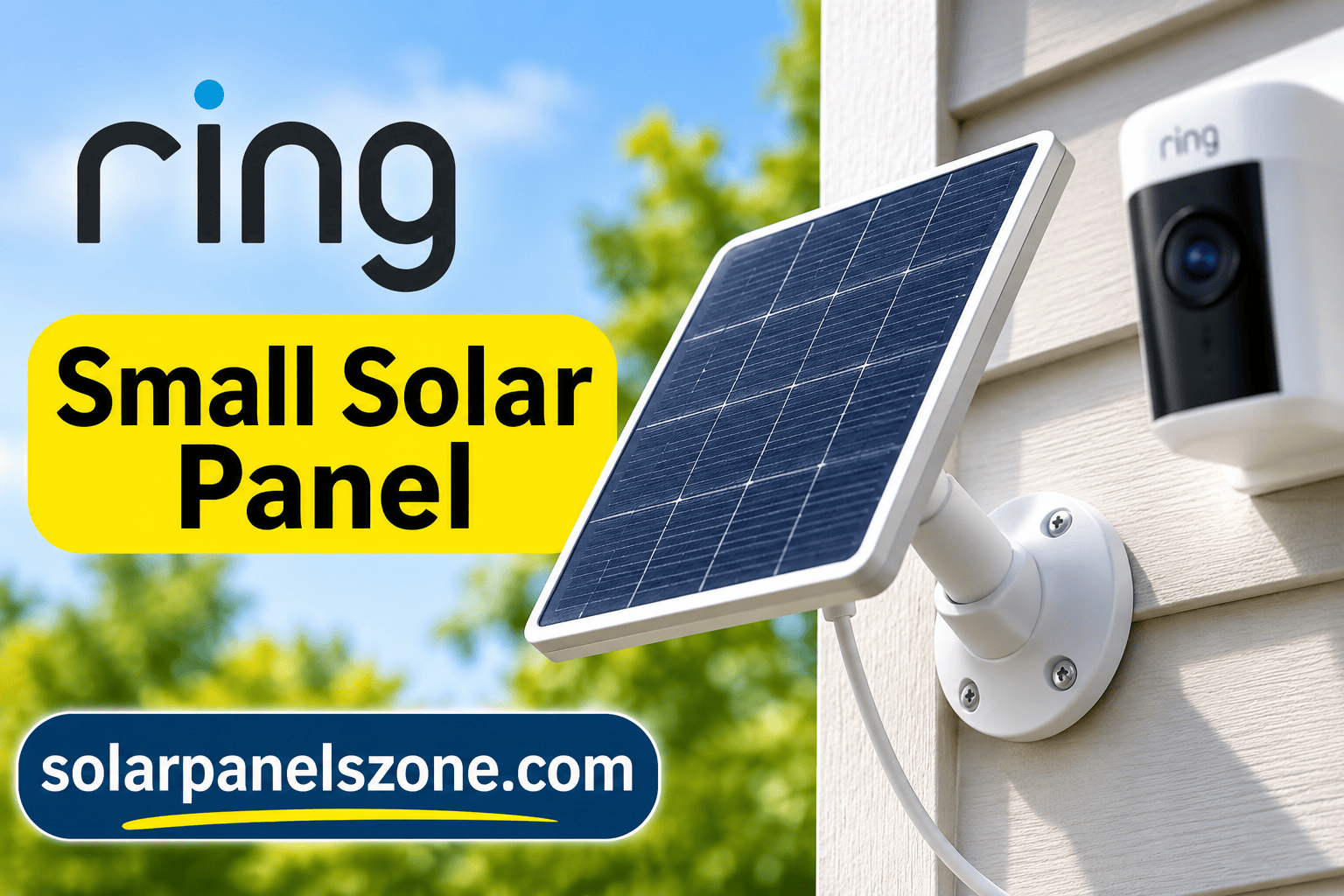
Ring Small Solar Panel guide: compatible cameras, sun hours, install steps, mounts, regional prices and what 1.9W can realistically do.
A battery camera is only as useful as its battery. If yours sits above a garage door or on a back wall, recharging it means a ladder, a cold evening and a dead camera in the meantime.
The Ring Small Solar Panel (USB-C) is Ring Small Solar Panel compact answer to that problem. It trickle-charges a compatible camera from direct sunlight so you recharge less often.
Here is what it does, which cameras it works with, how much sun it needs, and where its limits are.
Ring Small Solar Panel at a Glance
The Ring Small Solar Panel (USB-C) is a compact, weather-resistant solar charger for Ring Small Solar Panel USB-C cameras such as Spotlight Cam Plus and Pro. A bundled adapter supports some barrel-plug cameras. Ring Small Solar Panel recommends 3-4 hours of direct sunlight daily for best performance.
| Quick fact | Detail |
|---|---|
| Rated output | 1.9W, 5V DC |
| Size | 17.5 x 11.1 x 1.2 cm |
| Cable | 2 m (about 6.5 ft), with built-in cable management |
| Connector | USB-C, plus a USB-C to barrel plug adapter in the box |
| Colors | White and black |
| Operating range | -20.5°C to 48.5°C, weather resistant |
| Warranty | One-year limited (listed on Ring’s EU page) |
What It Is and Why People Buy It
Ring Small Solar Panel the Amazon-owned home security brand, describes this panel as having the same upgraded solar technology as its Solar Panel (2nd Generation), in a smaller body. You mount it near the Ring Small Solar Panel run the cable to the camera’s charging port, and sunlight tops up the battery.
The appeal is simple. A solar-fed Ring Small Solar Panel needs fewer manual recharges, which matters most for high walls, gates, outbuildings and second homes.
One reviewer on a retail site described a remote vacation home where the panel meant nobody had to visit just to recharge the camera. Reviews like that explain why this accessory sells well. Keep in mind that many retail reviews were written by customers who received promotional considerations, so treat the glowing ones as one input, not the verdict.
What About “Ring Small Solar Panel 260”?
If you searched for “260”, you will not find a Ring Small Solar Panel product with that name. We could not find one in Ring Small Solar Panel catalog, and it is not a listed wattage or model number on the product pages we reviewed.
It is most likely a stray suffix, a typo or an internal code from a seller listing. Everything in this guide applies to the Small Solar Panel (USB-C). If a listing claims a “260” version, ask the seller for the exact product name and compare it against Ring’s own page before paying.
Which Ring Small Solar Panel Does It Work With?
Compatibility is the first thing to check, because Ring Small Solar Panel cameras use two different power inputs. Newer ones charge over USB-C. Older ones use a barrel plug, which needs the adapter that comes in the box.
| Connection | Cameras listed by Ring |
|---|---|
| Direct USB-C | Spotlight Cam Plus, Spotlight Cam Pro, Stick Up Cam Pro, Outdoor Cam Plus |
| Barrel plug via included adapter | Outdoor Cam (Stick Up Cam) Battery and Solar, 2nd and 3rd Generation; Spotlight Cam Battery; Spotlight Cam Solar |
The Stick Up Cam 1st Generation Question
Ring Small Solar Panel regional pages do not agree here. Ring Small Solar Panel Canada page lists the Outdoor Cam (Stick Up Cam) 1st Generation as supported. Ring’s European page says the adapter route is not compatible with the Stick Up Cam 1st Generation.
The safest reading is to assume it is not supported unless the Ring Small Solar Panel store for your own country lists it. Do not buy on the strength of a different country’s page.
A Quick Compatibility Checklist
- Find your camera’s exact name and generation in the Ring Small Solar Panel app or on its box.
- Check whether it charges by USB-C or by barrel plug.
- Confirm the model appears on your country’s Ring Small Solar Panel product page.
- Check that the panel has a spot with direct sun (more on that below).
How the Ring Small Solar Panel Charges Your Camera
The panel turns direct sunlight into low-voltage power at 5V. That power travels down the cable and feeds the camera’s battery while the camera keeps working.
The word that matters is direct. Ring Small Solar Panel says its solar products need direct sunlight to stay charged, so bright cloud cover or shade will not do the same job.
How Many Hours of Sun Does It Need?
Most Ring Small Solar Panel pages recommend at least 3-4 hours of direct sunlight per day for the Small Solar Panel. A few European listings quote 2-3 hours. Plan for 3-4, and treat anything less as a bonus rather than a guarantee.
The Battery Math, Without the Hype
A 1.9W Ring Small Solar Panel, running at its full rating for 3 to 4 hours, would produce roughly 5.7 to 7.6 watt-hours a day on paper. That is the ceiling under ideal conditions.
Real output is lower. Ring Small Solar Panel angle, haze, heat, dust and shade all trim it, and your camera also draws power every time it detects motion, records or streams.
So the honest way to think about it is this: the panel offsets drain. It does not always outrun it.
Is 1.9W Enough for Your Camera?
It depends on how busy your camera is. This is where Ring Small Solar Panel own FAQ is blunt: charge level varies with device settings, usage and sun exposure, and the Ring Small Solar Panel may not hold the battery at 100%.
| Situation | What to expect |
|---|---|
| Quiet side or back yard, sunny, moderate motion alerts | Good fit. The panel usually keeps up |
| High-traffic area, many alerts, frequent live view | The panel slows the drain but may not stop it |
| Shaded wall or north-facing eaves (northern hemisphere) | Poor fit. Consider a different power option |
| Long cloudy or winter spells | Expect some manual recharging. Ring says charging resumes once strong sun returns |
One owner with dogs setting off alerts all day reported that the cameras stayed fully charged. That is one user’s experience, not a promise, but it shows that busy cameras can work out in a sunny spot.
Ways to Reduce Battery Drain
- Lower motion sensitivity and trim the motion zones to the area that matters.
- Use live view sparingly.
- Place the camera so it does not catch roads, trees or pets that trigger alerts all day.
- Keep the panel clean (see troubleshooting below).
How to Install the Ring Small Solar Panel
Installation takes about as long as hanging a shelf. You need a screwdriver and a drill if you are mounting on masonry.
Step 1: Choose the Spot
Pick a place with no obstruction from sun. Leave room for the panel body, which measures 17.5 x 11.1 x 1.2 cm.
Step 2: Face the Right Direction
In the northern hemisphere, face the panel south. In the southern hemisphere, face it north. This one change makes a big difference.
Step 3: Set the Angle
Ring suggests tilting the panel about 45 degrees toward the sky using the adjustable arm. The arm rotates and tilts up to 180 degrees, so you can re-aim it as the seasons change.
Step 4: Fix the Base
The mounting base attaches with two screws and anchors, both included. On walls, Ring recommends mounting the panel horizontally.
Step 5: Clip the Panel On
The panel clips onto the base. The arms double as a place to wrap excess cable.
Step 6: Connect the Camera
Plug the USB-C cable into a USB-C camera. For a barrel-plug camera, attach the adapter first.
Step 7: Tidy the Cable
Use the clips to keep the 2 m cable close to the wall. A loose cable catches wind and attracts tampering.
Step 8: Check the Battery in the App
Watch the battery level for several days. If it keeps falling, change the angle or location before assuming the panel is faulty.
Mounts, Accessories and Pricing
The base in the box works for most wall installs. If you want the camera and panel together without drilling extra holes, Ring sells dedicated mounts.
| Mount | Best for | US price (Ring) |
|---|---|---|
| Gutter Mount | Clip onto a gutter and adjust the angle | $24.99 |
| Pole and Wall Mount | More placement and angle options | $29.99 |
| Stake Mount | Soft dirt or grass | $39.99 |
What the Panel Costs by Region
Prices vary by country and retailer, and they change often. These are examples from Ring’s own regional stores at the time of writing, not a price guarantee.
| Region | Listed price |
|---|---|
| South Africa | R 899 |
| Sweden | 449 SEK |
| Australia | A$199 for the 4-pack |
Ring also sells 2-pack, 3-pack and 4-pack versions in some markets. Multi-packs usually make sense if you are equipping several cameras at once, but check the per-panel price against buying singles in your region.
Small Panel vs Larger Ring Solar Panels
The Small Solar Panel is not the only Ring option, and it is not the strongest.
| Small Solar Panel (USB-C) | Solar Panel (2nd Gen) | Solar Panel 6W (USB-C) | |
|---|---|---|---|
| Rated output | 1.9W | Not confirmed in sources reviewed | 6W |
| Built for | Spotlight Cam Plus/Pro, Stick Up Cam Pro, Outdoor Cam Plus, barrel-plug cameras via adapter | Earlier Ring solar-capable cameras | Outdoor Cam 4K Plus, Spotlight Cam 4K Plus |
| Best when | You want something compact and easy to reposition | You own an older camera that lists it | Your camera is a newer, hungrier 4K model |
| Notes | Retailer listing says it uses the same upgraded solar technology as the 2nd Gen panel | A UK retailer has listed a Ring USB-C panel at 4W | Shown as pre-order on Ring Canada. Ring says three hours of direct sun fully charges a camera battery |
If your camera is heavily used or you live where winters are dark, a larger panel is worth considering. If space, looks and easy repositioning matter more, the Small Solar Panel is the practical pick.
Ring Panel or a Generic Panel?
Generic solar panels are cheaper, and some people try them. One buyer who tried a generic panel before switching described it in blunt terms and said the Ring panel was the one to get.
The real risks with generics are mismatched voltage, wrong connectors and weaker weather sealing. The Ring panel is built to the camera’s 5V input and comes with the adapter and mounting hardware. If you go generic, you carry the compatibility risk yourself.
Troubleshooting: When the Battery Is Not Rising
| Symptom | Likely cause | Fix |
|---|---|---|
| Battery keeps dropping | Too little direct sun, or very busy camera | Move the panel, reduce motion sensitivity, or consider a larger panel |
| Charging seems weak | Panel facing the wrong way | Face south (northern hemisphere) or north (southern), tilt about 45 degrees |
| Output dropped over weeks | Dust, pollen, bird droppings | Wipe the panel gently with a soft damp cloth |
| No charge at all | Loose connector or wrong adapter | Reseat the USB-C cable. Use the adapter only for barrel-plug cameras |
| Winter shortfall | Low sun angle, short days | Re-tilt steeper, and plan a manual top-up during long dull spells |
| Panel will not suit camera | Unsupported model | Check your country’s compatibility list before returning |
Heat, Weather and Safety
The panel is weather resistant and rated from -20.5°C to 48.5°C. That covers most climates, but very hot regions need care. In peak summer, avoid mounting on a dark metal surface that bakes in the sun.
Weather resistant is not the same as waterproof. Do not submerge the panel or leave the cable connectors sitting in standing water.
Ring links to safety and compliance information on its product pages. Read it before installing, especially if you are fixing equipment to a roof edge or ladder-height wall.
Fitting Multiple Cameras: Notes for Landlords and Property Managers
If you manage a block, a rental portfolio or a small business with several cameras, the Small Solar Panel scales neatly. Each camera needs its own panel, and multi-packs can bring the cost down.
A few habits keep it manageable:
- Record each camera’s model and connection type (USB-C or barrel plug) before ordering.
- Walk the site at midday and note which walls get genuine direct sun.
- Set a quarterly check to wipe panels and review battery levels in the Ring app.
- Keep a spare adapter and a spare mount type on hand.
For critical coverage areas, a wired camera may serve you better than any solar setup.
Warranty and Where to Buy
Ring’s European page lists a one-year limited warranty. Check the terms on your own country’s page, since coverage and return rules differ.
Buy from Ring’s regional store or an authorized retailer, such as large electronics chains. Be cautious of unusually cheap marketplace listings and of sellers advertising unfamiliar variants. If you import a panel from another country, confirm that the warranty still applies.
FAQs
How much sunlight does the Ring Small Solar Panel need?
Ring recommends at least 3-4 hours of direct sunlight per day. A few European listings say 2-3 hours, so plan for the higher figure.
Which Ring cameras work with the Small Solar Panel?
Spotlight Cam Plus, Spotlight Cam Pro, Stick Up Cam Pro and Outdoor Cam Plus connect by USB-C. Stick Up Cam Battery and Solar (2nd and 3rd Gen), Spotlight Cam Battery and Spotlight Cam Solar work through the included barrel plug adapter.
Will it keep my camera at 100%?
Not always. Ring says charge level depends on device settings, usage and sun exposure. In sunny spots with moderate activity, many owners report that it keeps the battery topped up.
Does it work on cloudy days or in winter?
It charges poorly without direct sun. Ring says prolonged cloudy or winter weather may require extra manual recharging, and that the panel keeps the device powered again once enough direct sunlight returns.
Is the panel waterproof?
It is weather resistant and rated for -20.5°C to 48.5°C. That is built for rain and cold, but it is not designed to be submerged.
Which way should I point the panel?
Face south in the northern hemisphere and north in the southern hemisphere. Tilt it about 45 degrees toward the sky.
Can I use two panels on one camera?
Ring’s pages describe one panel per camera, and multi-packs are meant for several cameras. We did not find guidance on connecting two panels to a single camera, so do not assume it is supported.
Does it work with the 2nd Gen Spotlight Cam?
Ring lists Spotlight Cam Battery and Spotlight Cam Solar as working through the adapter. Product names vary by region, so confirm your exact model on your country’s Ring page.
Does dust or dirt matter?
Yes. A dirty surface cuts the light reaching the cells. Wipe it with a soft damp cloth when you check the battery.
Is “Ring Small Solar Panel 260” a real model?
We could not find one. Treat “260” as a seller code or typo, and match any listing against the Small Solar Panel (USB-C) page on Ring’s store.
Conclusion
The Ring Small Solar Panel is a sensible, compact way to cut down on camera recharging, as long as three things line up: your camera is on the supported list, the panel gets 3-4 hours of direct sun, and the camera is not triggering constantly.
Before you buy:
- Confirm your camera’s exact model and power input.
- Check your country’s Ring page for compatibility and price.
- Spend a day noting where direct sun actually lands.
- Install at about 45 degrees facing the sun, then watch the battery for a week.
- If the battery keeps sliding, reduce motion alerts, move the panel, or step up to a larger Ring panel.
Unfulfilled Points: hands-on test results, a verified wattage for the 2nd Gen panel, official guidance on extension cables, and installer certification norms could not be included because no reliable sources were available. Prices should be re-checked on your regional Ring store.
These information about solar panel mounting are gathered from different surveys, medical tests and tech giants like Tom’s Guide and more. Our top priority is to provide you valuable information.
For More Details About Different Solar Panels Click Here