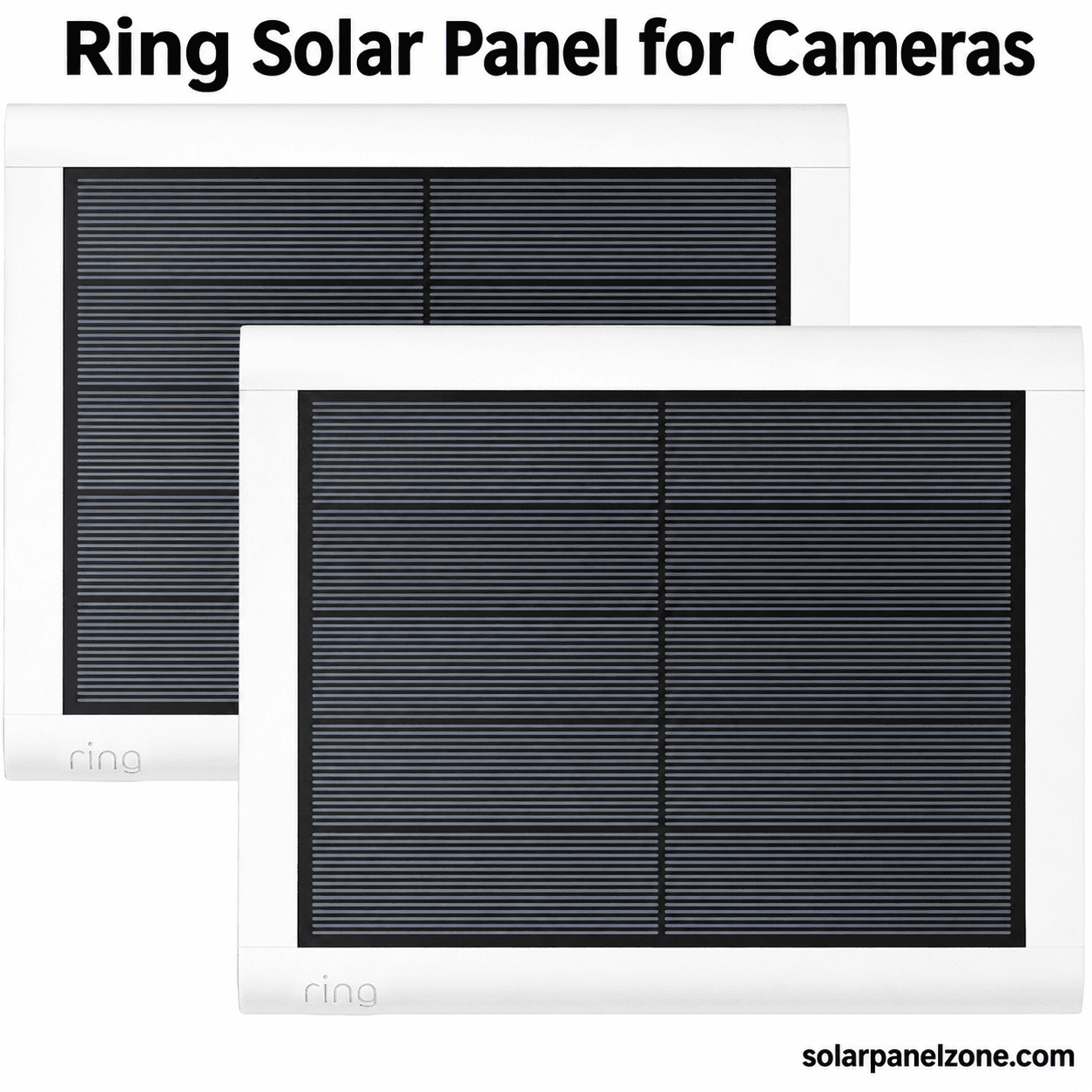
First, what does “ring cam solar panel 320” mean?
There is no Ring Solar Panel for Cameras product called the “320.” Ring Solar Panel for Cameras sells two solar panels for its battery Ring Solar Panel for Cameras, and neither carries that number. Ring Solar Panel for Cameras lists a Small Solar Panel rated at 1.9W and a Solar Panel (2nd Gen) rated at 4W, both USB-C with a barrel plug adapter. ring
The “320” most likely comes from a retailer’s internal product code, a typo, or a marketplace listing. If you saw it on a product page, check the wattage and connector type instead. Those two details tell you what you’re actually buying.
Quick answer: For most people, the 4W Solar Panel (2nd Gen) is the safer choice. It needs less sun and charges faster. The 1.9W panel suits sunny, low-traffic spots.
What a Ring Solar Panel for Cameras
A Ring solar panel is a trickle charger. It feeds a small, steady current into your Ring Solar Panel for Cameras battery while the sun is out. It extends the time between charges. It doesn’t turn the Ring Solar Panel for Camera into a mains-powered device.
Ring Solar Panel for Cameras describes its solar accessories as a supplement to the battery, not a substitute, and says they don’t remove the need to recharge it. Keep that in mind and the rest of this guide will make sense. ring
Who it’s for
- Homeowners with a Stick Up Ring Solar Panel for Cameras or Spotlight Cam in a hard-to-reach spot
- Renters who can’t run wiring
- Installers and property managers handling several Ring Solar Panel for Cameras at once
Who it isn’t for
- Ring Solar Panel for Cameras in deep shade with no sun at any point in the day
- Very high-activity locations, such as a Ring Solar Panel for Cameras facing a busy street, where the Ring Solar Panel for Cameras drains faster than the panel can refill it
Which Ring cameras work with a solar panel?
Compatibility depends on the connector, not just the Ring Solar Panel for Cameras name. Ring’s compatibility information splits cameras into two groups.
Ring Solar Panel for Cameras that plug in directly (USB-C)
Spotlight Ring Solar Panel for Cameras Plus, Spotlight Cam Pro, and Stick Up Ring Solar Panel for Cameras Pro use the USB-C solar panels directly. Ring’s own compatibility page also lists the Outdoor Cam Plus in this group. ring
Ring Solar Panel for Cameras that need the barrel plug adapter
With the included USB-C to barrel connector adapter, the panels also work with Stick Up Ring Solar Panel for Cameras Battery and Solar (2nd and 3rd Gen), and Spotlight Cam Battery and Solar. ring
Ring Solar Panel for Cameras that don’t work
The first-generation Stick Up Ring Solar Panel for Cameras is not compatible. lowes
Doorbells are a different product
Ring Solar Panel for Cameras doorbells use different solar chargers, with micro-USB or fork connectors depending on the model. Ring Solar Panel for Cameras also notes that its camera solar panel can’t connect to an existing mechanical or digital chime. If you’re shopping for a doorbell, make sure the listing says “doorbell.” ring
Tip: Open the Ring Solar Panel for Cameras app and check your device’s exact name before you buy. Ring brands some cameras “Stick Up Cam” and others “Outdoor Cam,” and the naming varies by region.
1.9W vs 4W: which Ring Solar Panel for Cameras should you buy?
The wattage tells you how much power the Ring Solar Panel for Cameras can produce in good sun. The sunlight requirement tells you how forgiving it is.
| Small Solar Panel | Solar Panel (2nd Gen) | |
|---|---|---|
| Rated power | 1.9W | 4W |
| Connector | USB-C, with barrel adapter | USB-C, with barrel adapter |
| Ring Solar Panel for Cameras recommended daily sun | At least 3–4 hours | At least 2–3 hours |
| Best fit | Sunny, low-activity spots | Busier Ring Solar Panel for Cameras, mixed or cloudy climates |
Ring Solar Panel for Cameras recommends at least 3 to 4 hours of direct sunlight for the Small Solar Panel and 2 to 3 hours for the 2nd Gen panel. So the larger panel isn’t only about speed. It also leaves you more margin for shade and weather. ring
Retail listings describe the 2nd Gen panel as charging up to 60% faster than the previous generation, with a mount that rotates 360° and tilts 180°. Treat that as a manufacturer-reported figure rather than something you’ll necessarily measure at home. wellbots
A simple way to decide
- Do you get strong, direct sun for most of the day? If yes, either panel can work. If not, choose the 4W.
- Does the camera record a lot? Busy driveways and streets trigger many events. Choose the 4W.
- Do you live somewhere with long, dark winters? Choose the 4W, and plan for the panel to fall behind during the darkest weeks.
- Is the spot only partly sunny? Consider relocating the panel on its cable rather than buying more wattage.
Why your Ring solar panel might say “Not Connected”
This is the most common source of confusion, and it often isn’t a fault.
Ring’s solar accessories don’t begin charging the camera until its battery drops below 90%, and the solar device only shows as connected when it has stored power. Ring says this protects the lithium-ion battery’s lifespan. A camera sitting at 95% with a “Not Connected” label can be completely normal. ring
There’s a second wrinkle. Some owners find the app doesn’t clearly show whether charging is actually happening. Community threads include users saying support told them the app doesn’t show whether the panel is charging the battery. Judge the panel by the battery trend over several sunny days, not by a single status check. ring
How to install a Ring solar panel
You don’t need electrical skills, but placement matters more than anything else.
- Confirm compatibility. Check your camera model in the Ring app.
- Pick the sunniest spot you can. In the Northern Hemisphere, that’s usually a south-facing wall, eave, or pole. In the Southern Hemisphere, aim north.
- Fix the mounting base. The kit includes an adjustable mounting base with cable management, screws, anchors, and cable clips. bestbuy
- Tilt the panel. Ring recommends angling it about 45 degrees toward the sky. ring
- Run the cable and secure it. Keep it tidy and out of reach of tampering.
- Connect to the camera. Plug straight into a USB-C camera, or fit the barrel adapter for older models.
- Watch the battery for a week. Adjust the angle if the level keeps falling.
The panel and camera don’t have to sit side by side. A shaded camera can still draw power from a panel mounted in a sunnier spot, as long as the cable reaches. If the cable is too short, Ring has a dedicated FAQ entry on that problem, so check its support page for options before improvising.
What affects how well it charges
Sunlight and weather
Direct sun is what counts. A bright, overcast day produces far less than a clear one. Several cloudy days in a row can leave the panel without enough sun to charge. ring
When sunny weather returns, the panel picks up again. Ring says it will keep the device powered once direct sunlight is back. ring
Temperature
Batteries dislike cold. Ring’s batteries are designed to charge between 0°C and 45°C. In freezing weather, the panel can be in full sun and still struggle to put charge in. One retailer listing gives an operating range of −5°F to 120°F for the panel itself, so check the spec sheet for your region. ringbestbuy
How busy the camera is
This is the factor people overlook. Frequent motion events, snapshot capture, advanced motion detection, and long recording lengths can all drain the battery faster, even with a solar device connected. ring
If your battery still falls on sunny days, the panel may be working fine. The camera may simply be using more than the panel can supply. Ring suggests reducing motion sensitivity under Motion Settings in the app. ring
Dirt and debris
A dusty panel charges less. Ring says to clean it with a damp, soft cloth, with no cleaning fluids or abrasives, and every two to four weeks in dusty climates. ring
Climate planning: what to expect where you live
| Climate | What to expect | Suggested approach |
|---|---|---|
| Sunny, dry | Strong, steady charging | Either panel; clean regularly |
| Mixed, four seasons | Good summers, weaker winters | 4W panel, plan a spare battery |
| Cloudy or low winter sun | Frequent shortfalls | 4W panel, steeper tilt, lower motion sensitivity |
| Heavy snow | Panel can be covered | Clear it, mount above snow line if possible |
Availability and naming vary by country, and Ring publishes localized support pages for several regions. Check your local Ring site for the exact product names and bundles sold where you live.
Troubleshooting: what to check, in order
Work through these from most to least likely.
- Check the battery level. Above 90%, “Not Connected” is expected.
- Check the sunlight. Watch the panel through the day. Shade from a roofline, tree, or neighboring building is the usual culprit.
- Check the connection. Detach the cable, clear dust or debris from the connector, and reattach it. A Ring community moderator suggests checking Device Health in the app to see whether a solar panel shows as connected. ring
- Reset the camera if needed. The same guidance suggests holding the camera’s setup button for about 20 seconds, and resetting the camera, not the panel. ring
- Clean the panel.
- Review motion settings. High activity can outpace a perfectly working panel.
- Confirm compatibility. An incompatible accessory won’t charge. If it isn’t compatible, the fix is a return, not a reset.
Official Ring panel vs third-party panels
Several third-party brands sell panels advertised as compatible with Ring cameras, usually in multi-packs. The appeal is price.
One review site says a 2-pack of 4W third-party panels costs less than a single official Ring panel, and lists a 5W third-party option too. howtotechinfo
The trade-offs are real, though.
Where third-party panels shine
- Lower cost per panel, especially for multi-camera homes
- Often include the connector and adapter
- Many buyers report good everyday results
Where they can disappoint
- Reviews are mixed on longevity. One reviewer reported a third-party panel lasting only about a year. bestbuy
- Support and returns depend on the seller, not Ring
- Specs can be vaguer, so verify connector type and wattage before buying
For a single camera in a demanding spot, the official panel keeps things simple. For several cameras on one property, a reputable multi-pack can make financial sense. Either way, check the connector against Ring’s compatibility list first.
Pricing: what to expect
Prices vary by country, retailer, and bundle, and they change often, so check current listings rather than relying on a fixed figure. As a rule of thumb, the 4W panel costs more than the 1.9W, and third-party multi-packs tend to cost less per panel than the official option.
If you’re buying for a client or a multi-unit property, factor in mounting hardware, cable length, and the cost of a return if a camera model turns out to be incompatible.
Alternatives to solar
Solar isn’t the only way to cut down on battery swaps.
- Hardwired kit. Ring lists a hardwired kit for the Spotlight Cam Pro and Plus. It suits spots where you can run a cable. ring
- Spare or quick-release battery. Swap and charge indoors. This works well when sun is limited.
- Reduce activity. Tighter motion zones and shorter recordings extend battery life with no new hardware.
Common mistakes to avoid
- Buying by a code like “320.” Match the connector and camera model instead.
- Mounting in shade. It’s the most common reason panels underperform.
- Expecting a full battery every day. The panel supplements, it doesn’t replace.
- Reading “Not Connected” as a fault. Check the battery percentage first.
- Buying a doorbell charger for a camera, or the reverse. The connectors differ.
- Ignoring cleaning. Dust cuts output more than people expect.
Frequently asked questions
Is there a Ring solar panel 320?
No. Ring’s current camera panels are the 1.9W Small Solar Panel and the 4W Solar Panel (2nd Gen). “320” is likely a listing code or typo.
Does a Ring solar panel fully charge the camera?
It extends battery life but isn’t a guaranteed full charge. Results depend on sunlight, weather, and how often the camera records.
Why does my Ring app say the solar panel is “Not Connected”?
The panel only starts charging when the battery is below 90%, and it shows as connected only when it has stored power. Above 90%, this is normal.
How many hours of sun does a Ring solar panel need?
Ring recommends at least 3–4 hours of direct sunlight for the Small Solar Panel and at least 2–3 hours for the 2nd Gen panel.
Does it work in winter or on cloudy days?
Yes, but more slowly. Several overcast days can leave it short on sun, and cold limits battery charging. It resumes charging when direct sun returns.
Can one solar panel charge two cameras?
No. Each panel connects to one camera.
Can I use a Ring camera solar panel with a doorbell?
No. Doorbells use different solar chargers with different connectors, and the camera panel can’t power an existing chime.
Are third-party panels safe for Ring cameras?
Many people use them successfully, but quality varies. Check the connector, wattage, and the seller’s return policy, and read recent reviews.
How do I stop the battery from draining even with solar?
Lower motion sensitivity, shorten recordings, and limit snapshots in the Ring app. High activity can outpace even a well-placed panel.
Conclusion
The “ring cam solar panel 320” search points to a real need but no real product. What matters is your camera’s connector, how much direct sun the spot gets, and how often the camera records.
Choose the 4W panel if you’re unsure. Mount it where the sun actually reaches, tilt it toward the sky, and give it a week before judging the result. If the app says “Not Connected” while the battery is high, that’s normal.
Where solar can’t keep up, a spare battery or a hardwired kit may serve you better than a bigger panel.
Unfulfilled Points: First-hand test data, original install photos, and an interactive decision tool couldn’t be included because they require real testing and assets. Panel weather-resistance (IP) ratings, regional safety markings, and extension-cable options weren’t verified, so they were left out rather than guessed.
These information about solar panel mounting are gathered from different surveys, medical tests and tech giants like Tom’s Guide and more. Our top priority is to provide you valuable information.
For More Details About Different Solar Panels Click Here