Solar Powered Plug In Outlet 210: Types, Sizing, Safety & Buying Guide 2026
SGE Short Answer Summary
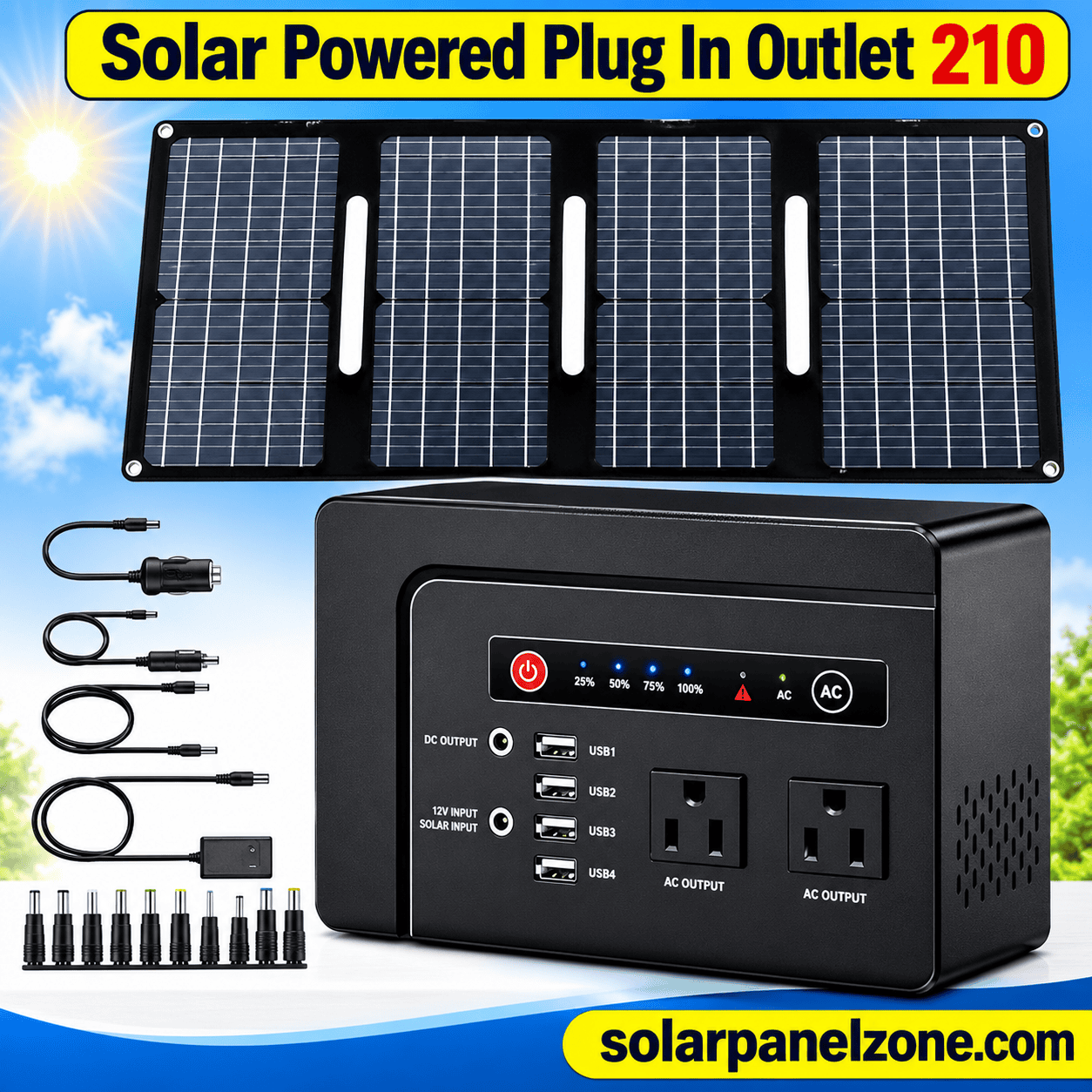
A solar powered plug in outlet is a solar panel paired with a battery or inverter that gives you a standard AC socket. Some units store power for appliances. Others feed power back into your home circuit. The “Solar Powered Plug In Outlet 210” usually means a wattage or capacity rating.
Table of Contents
- Introduction
- SERP Intent Analysis
- What a Solar Powered Plug In Outlet Is
- Why It Matters and Who It Is For
- How It Works
- Types and Variants
- What “210” Likely Means
- Sizing Framework
- Step-by-Step Setup
- Safety, Standards and Regulations
- Regional and Local Considerations
- Pros and Cons
- Buying Decision Framework
- Pricing
- Alternatives
- Common Mistakes and Warnings
- Checklists
- Entity Glossary
- People Also Ask FAQs
- AI Overview Trigger Q&A
- Conclusion and Action Steps
- Suggested Internal Link Topics
Introduction
Electricity prices, outages and renting restrictions have pushed people toward Solar Powered Plug In Outlet 210 they can set up without an electrician. The phrase “solar powered plug in outlet” covers a few very different products. That is why searchers get confused.
If you typed “solar powered plug in outlet 210”, you are probably doing one of three things:
- Comparing a specific listing with “Solar Powered Plug In Outlet 210” in its name or rating.
- Trying to power a few devices without wiring.
- Checking whether plugging solar into a wall socket is legal and safe.
This guide answers all three. It is written so you can skip to the section you need.
SERP Intent Analysis
Based on how this query behaves, results typically mix product listings, comparison articles, forum threads and safety explainers.
| Level | Intent | What the searcher needs |
|---|---|---|
| Primary | Commercial investigation | Which type of solar outlet or plug 210-in system fits my need |
| Secondary | Informational | How it works, what the rating means, what it can run |
| Tertiary | Micro-decisions | Panel size, battery chemistry, outdoor rating, legality, price, warranty |
Intent class: Mixed intent (commercial investigation plus informational, with a transactional tail and a mild local tail for availability, rules and installers).
What a Solar Powered Plug In Outlet 210 Is
It is any Solar Powered Plug In Outlet 210-fed power source that offers a normal AC socket you can plug devices into, without hard-wiring.
There are two main families:
- Off-grid or portable: a panel charges a battery in a portable power station. The station has AC outlets. Nothing connects to your house wiring.
- Grid-tied plug-in Solar Powered Plug In Outlet 210: panels connect to a microinverter that plugs into a household outlet and offsets your consumption. Often called balcony solar or plug-in PV. Germany’s Balkonkraftwerk is the best-known example.
A third, smaller family is solar-powered outdoor outlets or lighting posts, which run low-power loads such as lights, fountains or sensors.
Why It Matters and Who It Is For
Why it matters: it lowers the barrier to using Solar Powered Plug In Outlet 210. No roof, no installer and often no permit in places that allow it.
Best for:
- Renters and apartment dwellers with a balcony or yard.
- People in areas with frequent load-shedding or outages.
- Campers, van and RV owners, and outdoor workers.
- Garden, shed and workshop owners without mains power.
- Households wanting to cut a small, steady base load such as a fridge or router.
Not ideal for: whole-home backup, heavy loads such as air conditioners or water heaters, or shaded sites.
How It Works
Off-grid portable system
- Panels convert sunlight to DC.
- A charge controller (usually MPPT) regulates it into a battery.
- An inverter turns battery DC into AC.
- You plug devices into the AC outlet.
Grid-tied plug-in system
- Panels produce DC.
- A microinverter converts it to grid-synchronised AC.
- The inverter plugs into an outlet.
- Your home appliances use that power first. Only the remainder, if any, flows outward.
Grid-tied inverters shut down automatically when grid power drops (anti-islanding). This protects utility workers and is a core safety requirement.
Expert why-it-matters: the grid-tied design has no battery, so it only works when the sun shines and the grid is up. The portable design works during outages but costs more per usable watt.
Types and Variants
| Type | Storage | Works in outage | Typical use | Key limit |
|---|---|---|---|---|
| Portable power station + foldable panel | Yes | Yes | Camping, backup, tools | Battery capacity |
| Fixed panel + battery + inverter kit | Yes | Yes | Sheds, cabins, small off-grid | Needs basic wiring |
| Plug-in Solar Powered Plug In Outlet 210 (microinverter) | No | No | Offsetting daily electricity | Local legality, inverter cap |
| Solar Powered Plug In Outlet 210 or light post | Small | Yes | Garden lights, sensors | Very low power |
What “210” Likely Means
Use this table to decode a listing. Always confirm against the product’s datasheet.
| If the listing shows | It probably means | What to check |
|---|---|---|
| 210 W | Panel peak power under test conditions | Panel size, voltage, connector type |
| 210 Wh | Battery energy capacity | Usable capacity, AC output watts |
| 210 as a model code | Brand-specific number | Spec sheet, not the name |
| 210 mm | Cell or wafer size in the panel | Not a power rating; ask for watts |
A 210 Wh station can run a 50 W device for roughly 3 to 4 hours after inverter losses. It will not run a kettle, heater or air conditioner.
Sizing Framework
Step 1: List your loads
Multiply device watts by hours per day.
| Device | Typical watts (check label) | Hours/day | Wh/day |
|---|---|---|---|
| Phone charging | 10 to 20 | 2 | 20 to 40 |
| Laptop | 45 to 90 | 4 | 180 to 360 |
| Wi-Fi router | 6 to 15 | 24 | 144 to 360 |
| LED lights (a few) | 10 to 30 | 5 | 50 to 150 |
| Small fan | 20 to 60 | 6 | 120 to 360 |
Step 2: Estimate solar yield
Daily energy is approximately: panel watts × peak sun hours × 0.7 to 0.8 (real-world losses).
Illustrative example: a 210 W panel with 4.5 peak sun hours and 0.75 efficiency yields about 210 × 4.5 × 0.75 ≈ 709 Wh per day. Peak sun hours vary by location and season, so use a local solar resource tool such as NREL PVWatts or Global Solar Atlas.
Step 3: Match storage
- Aim for battery capacity of 1 to 2 days of your needs if you want overnight use.
- Check continuous AC watts and surge watts against your biggest load.
Decision shortcut
- Under 300 Wh/day: a small portable station and one panel.
- 300 to 1,000 Wh/day: a mid-size station with 200 to 400 W of panels.
- Above that: a fixed kit, or reconsider the goal.
Step-by-Step Setup (Portable System)
- Place the panel where it gets unshaded sun from about 9 am to 3 pm.
- Angle it toward the equator (south in the northern hemisphere).
- Match the panel’s voltage and amp limits to the station’s solar input range.
- Connect the panel to the station before plugging in loads.
- Check the display for input watts.
- Plug devices into the AC outlet or USB ports.
- Keep the station shaded and ventilated. Panels like sun, batteries do not like heat.
Safety, Standards and Regulations
Warnings first
- Never use a cable with a plug on both ends to feed power into a wall socket. Exposed pins can be live.
- Do not connect a non-certified grid-tied inverter to household wiring.
- Do not charge lithium batteries in freezing temperatures unless the unit explicitly supports it.
Standards worth knowing
| Standard | Applies to |
|---|---|
| IEC 61215 / IEC 61730 | PV module quality and safety |
| UL 1741 / IEC 62109 | Inverter safety |
| UL 9540 / UL 2743 | Energy storage and portable power packs |
| UL 3741 | Photovoltaic hazard control (US) |
| NEC Article 690 | US solar wiring rules |
| VDE-AR-N 4105 | German grid connection rules for small generators |
| IP65 / IP67 | Dust and water resistance ratings |
| UN 38.3 | Lithium battery transport testing |
Regulation is changing
Germany raised the plug-in inverter limit to 800 VA in 2024. Some US states have been moving to ease rules for plug-in solar. Many other places still require approval or a utility notice. Check your local rules before buying a grid-tied unit.
Regional and Local Considerations
Search terms like “solar outlet near me”, “solar power station dealer in [city]” and “[city] Solar Powered Plug In Outlet 210 installer” show that buyers want local stock, warranty support and rules.
| Region | What to know |
|---|---|
| United States | Outlet plug-in Solar Powered Plug In Outlet 210 legality varies by state and utility. Portable stations are unrestricted. Look for UL listings. |
| European Union and Germany | Plug-in PV is established. Register the system, use a certified inverter. |
| United Kingdom | Plug-in Solar Powered Plug In Outlet 210 is not yet standard practice. Check current guidance. |
| South Asia (for example Pakistan, India) | High sun, grid instability. Portable stations and hybrid kits are popular. Grid-tied export is governed by net metering rules, so ask your distribution company. Voltage is typically 220 to 240 V, so confirm the unit’s output. |
| Middle East and Africa | Very high solar yield, heat is the main stress. Look for wide operating temperature range and good ventilation. |
Local search modifiers to use: “authorized dealer”, “warranty service centre”, “installation cost”, “net metering”, “import duty”, “spare parts”.
Provider types to compare: local Solar Powered Plug In Outlet 210 installers, electronics retailers, online marketplaces and brand-authorized distributors.
Service area language to check: does the seller offer delivery, warranty claims and battery replacement in your city?
Pros and Cons
| Pros | Cons |
|---|---|
| No wiring for portable types | Limited power compared with rooftop solar |
| Quiet, no fuel | Weather and shade dependent |
| Works as backup (portable) | Plug-in grid-tied units may be restricted |
| Easy to move or resell | Batteries age and are costly to replace |
| Low maintenance | Cheap listings may overstate ratings |
Buying Decision Framework
Score each option from 1 to 5 on these criteria.
- Purpose: backup, camping, bill savings or garden use?
- Energy need: Wh/day from your load list.
- Output power: continuous AC watts above your largest load, with surge headroom.
- Battery chemistry: LiFePO4 usually offers longer cycle life (commonly 2,000 to 3,500 cycles, check the spec) than standard lithium-ion.
- Solar input: maximum input watts and voltage range.
- Weather rating: IP rating for outdoor panels and connectors.
- Certification: UL, CE, IEC or local equivalents.
- Warranty and support: in your country, not just the seller’s.
- Total cost: price per usable Wh, not per rated watt.
Final decision paths
- Want power during outages: buy a portable station with panels.
- Want to lower daytime bills and your rules allow it: buy a certified plug-in solar kit.
- Only need garden lighting: buy a Solar Powered Plug In Outlet 210 light post.
- Need more than about 1 kW regularly: ask an installer for a fixed system.
Pricing
Prices vary widely by country, brand and import costs, so no single figure is reliable. Use these as relative guides (Source: check current retailer listings in your market).
| Category | Relative cost |
|---|---|
| Small portable station (about 200 to 300 Wh) | Low |
| 200 W foldable panel | Low to moderate |
| Mid-size station (about 1 kWh) | Moderate to high |
| Certified plug-in solar kit | Moderate |
| Fixed hybrid system | High, installation extra |
Compare cost per usable Wh, add shipping, duties and warranty coverage.
Alternatives
- Generator: more power, but fuel, noise and fumes.
- UPS (uninterruptible power supply): good for short outages, not solar.
- Rooftop solar with battery: best long-term value for owners.
- Community or shared solar: an option for renters in some regions.
- DC solar lighting and USB solar chargers: cheaper for tiny loads.
Common Mistakes and Warnings
- Confusing watts (power) with watt-hours (energy).
- Buying on peak panel rating and ignoring real-world output.
- Placing the panel in partial shade. Even a small shadow can cut output sharply.
- Running heating or cooling loads on a small station.
- Ignoring continuous versus surge output.
- Using uncertified inverters or homemade backfeed cables.
- Leaving connectors exposed to rain without a proper rating.
- Assuming “Solar Powered Plug In Outlet 210” is a standard. Check the datasheet.
Checklists
Before you buy
- Confirm what “Solar Powered Plug In Outlet 210” refers to (W, Wh or model).
- Write down your daily Wh needs.
- Check continuous and surge AC output.
- Verify certifications and local plug type.
- Confirm warranty and service in your area.
- Check local rules for any grid-connected unit.
After installation
- Panel unshaded and secured against wind.
- Connectors dry and fully seated.
- Input watts match expectations.
- Battery kept within temperature limits.
- Firmware and manual saved.
Entity Glossary
| Term | Meaning |
|---|---|
| Photovoltaic (PV) | Technology converting light to electricity |
| MPPT | Maximum Power Point Tracking, a charge controller method |
| Microinverter | Small inverter attached to one or two panels |
| Anti-islanding | Automatic shutdown when the grid is down |
| LiFePO4 | Lithium iron phosphate battery chemistry |
| Peak sun hours | Equivalent hours of full-intensity sunlight per day |
| Surge power | Short burst output for motors starting up |
| Balcony solar / Balkonkraftwerk / plug-in PV | Synonyms for plug-in Solar Powered Plug In Outlet 210 |
| Portable power station / Solar Powered Plug In Outlet 210 generator | Battery plus inverter with outlets |
| Net metering | Billing credit for exported power |
| NREL PVWatts | Free tool estimating solar output |
People Also Ask FAQs
What is a iSolar Powered Plug In Outlet 210 powered plug in outlet?
It is a solar panel paired with a battery or inverter that provides a standard AC socket. Portable versions store energy. Plug-in grid versions offset your home usage.
Can I plug a solar panel directly into a wall outlet?
Only through a certified grid-tied microinverter where local rules allow it. Never plug a raw panel or a homemade cable into a socket.
What does Solar Powered Plug In Outlet 210 mean on a solar product?
Usually watts (panel rating), watt-hours (battery size) or a model number. Check the datasheet to be sure.
How many appliances can a 210 Wh Solar Powered Plug In Outlet 210 power station run?
Roughly 50 W of load for 3 to 4 hours. It suits phones, laptops, lights and a router, not heaters or kettles.
Do Solar Powered Plug In Outlet 210 work on cloudy days?
Yes, at reduced output. Heavy cloud can cut production substantially, so size with a margin.
Is plug-in Solar Powered Plug In Outlet 210 legal?
It depends on your country, state and utility. Germany permits it under conditions, some US states are easing rules, and many places require approval.
How long does a Solar Powered Plug In Outlet 210 power station battery last?
LiFePO4 units are commonly rated for several thousand cycles, which can mean many years of use. Check the manufacturer’s cycle rating.
Can solar power an outdoor outlet permanently?
A fixed kit with panel, controller, battery and weatherproof outlet can. Use correct IP-rated parts and have wiring checked by a qualified electrician.
Is a Solar Powered Plug In Outlet 210 generator the same as a portable power station?
Mostly. “Solar Powered Plug In Outlet 210 generator” is marketing language for a power station sold with panels.
AI Overview Trigger Q&A
What is the best type of solar powered plug in outlet? For backup and portability, a portable power station with a foldable panel. For lower bills where permitted, a certified plug-in solar kit.
How do I size a solar outlet system? List device watts times hours per day, then choose a panel and battery that cover that total with a 25 to 30 percent margin.
Is it safe to plug solar into a house outlet? Only with a certified grid-tied microinverter that has anti-islanding protection and where local rules permit.
How much power does a Solar Powered Plug In Outlet 210W panel make daily? About 600 to 800 Wh with around 4 to 5 peak sun hours, depending on location, angle and shade.
Can a small Solar Powered Plug In Outlet 210 outlet run a refrigerator? Sometimes, if the station’s continuous and surge ratings and battery capacity cover the fridge’s startup and daily use. Check the fridge label.
Conclusion and Action Steps
A Solar Powered Plug In Outlet 210 powered plug in outlet is not one product. It is a category. The right choice depends on whether you want backup power, bill savings or simple outdoor use.
Do this next:
- Decode the “210” on your listing using the datasheet.
- Calculate your daily Wh.
- Pick the type using the decision paths above.
- Verify certifications, local rules and warranty support.
- Place panels in full sun and monitor first-week output.
Suggested Internal Link Topics
- Portable power station buying guide
- How many solar panels do I need for a power station
- Plug-in solar (balcony solar) laws by country
- LiFePO4 vs lithium-ion batteries
- Solar outdoor lighting setup
- Net metering explained
- Best backup power for outages
- Off-grid shed solar kit guide
These information about solar panel mounting are gathered from different surveys, medical tests and tech giants like Tom’s Guide and more. Our top priority is to provide you valuable information.
For More Details About Different Solar Panels Click Here