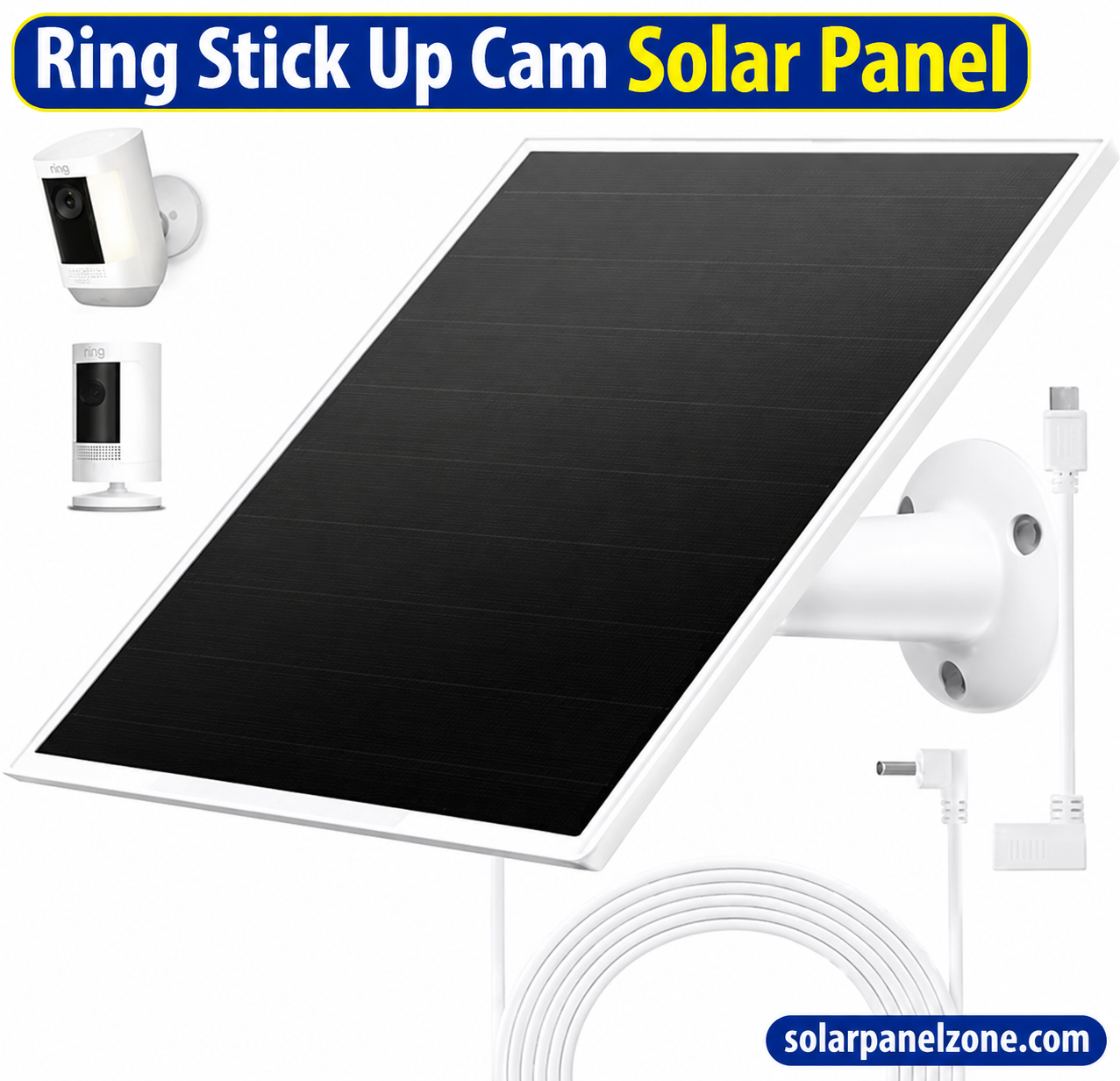
SGE Short Answer Summary
The Ring Stick Up Cam works with Ring’s solar panels, but “590” isn’t a confirmed Ring Stick Up Cam Solar Panel model number. Match the panel connector (barrel plug or USB-C) to your camera generation, mount it with 2–3 hours of direct daily sunlight, and verify any listing labeled “590” before buying.
Table of Contents
- What ” Ring Stick Up Cam Solar Panel Ring Stick Up Cam Solar Panel 590″ Means
- SERP Intent Analysis
- How a Ring Stick Up Cam Solar Panel Ring Solar Panel Works
- Types and Variants Compared
- Compatibility Checker
- Decision Framework
- Installation: Step by Step
- Placement, Sunlight and Climate
- Pros and Cons
- Common Mistakes and Warnings
- Alternatives
- Regional and Local Considerations
- Pricing Guidance
- Checklists
- Entity Glossary
- People Also Ask FAQs
- AI Overview Trigger Q&A
- Conclusion and Action Steps
- Suggested Internal Link Topics
Introduction
You searched “ring stick up cam solar panel 590” because you want your Ring Stick Up Cam Solar Panel powered without climbing a ladder every few weeks to recharge it. That’s the right instinct, but one wrong connector can leave you with a panel that doesn’t plug in.
This guide solves three things in order: what “Ring Stick Up Cam Solar Panel 590” likely means, which panel fits your camera, and how to install and buy it safely.
What “Ring Stick Up Cam Solar Panel 590” Means
No Ring product page reviewed lists a model called “Ring Stick Up Cam Solar Panel 590.” The number is probably one of these:
- A retailer price or listing code. Marketplaces often add numbers to titles.
- A third-party panel’s wattage, size or SKU. Not a Ring Stick Up Cam Solar Panel Ring designation.
- A typo or partial model code.
- A currency-specific price (for example in a local currency).
Why it matters: buying by an unverified number risks the wrong connector or a non-genuine panel. Confirm the exact camerRing Stick Up Cam Solar Panel a generation first, then the panel.
SERP Intent Analysis
| Level | Intent | What the searcher needs |
|---|---|---|
| Primary | Commercial Investigation | Which solar Ring Stick Up Cam Solar Panel panel works with my Stick Up Cam, and is it worth it? |
| Secondary | Informational | Compatibility, charging time, weather performance, setup |
| Tertiary | Transactional / Local micro-decisions | Where to buy, genuine vs. third-party, barrel plug vs. USB-C, mounting height |
Intent class: Mixed (Commercial + Informational + Local).
SERP-gap note: the numeric token “Ring Stick Up Cam Solar Panel 590” has no authoritative answer, so most pages ignore it. This guide addresses it directly.
How a Ring Stick Up Cam Solar Panel Ring Solar Panel Works
A Ring solar panel is a small outdoor panel that trickle-charges your camera’s battery through a cable. It does not replace the battery. It tops it up.
- Sunlight hits the Ring Stick Up Cam Solar Panel and produces a small current.
- The cable carries that current to the camera’s charging port.
- The camera’s battery stores it for night use and cloudy periods.
- Ring recommends at least 2–3 hours of direct sunlight per day for best performance (Source: Ring Stick Up Cam Solar Panel product page).
Ring Stick Up Cam Solar Panel support FAQ states the panel works on cloudy days too, though sunnier placement charges faster (Source: Ring Stick Up Cam Solar Panel Support).
Types and Variants Compared
| Panel | Connector | Key facts | Typical cameras |
|---|---|---|---|
| Original Ring Stick Up Cam Solar Panel Ring Solar Panel | Micro-USB / barrel plug depending on generation | 2W, 6V; 7.75 × 5.50 × 0.50 in; 10 ft USB cable; operating range -20°F to 120°F (-28°C to 48°C) | Early Stick Up Cam models |
| Super Ring Stick Up Cam Solar Panel Solar Panel | Barrel plug | Ring states it provides 2.5× the power of the original | Outdoor Cam (formerly Stick Up Cam 3rd Gen), Spotlight Cam Battery (1st Gen), Stick Up Cam Battery (2nd Gen) |
| Ring Stick Up Cam Solar Panel Solar Panel (USB-C) | USB-C, with included USB-C to barrel adapter | Backward compatible with barrel-plug cameras via the adapter | Stick Up Cam Pro, Spotlight Cam Plus/Pro, Outdoor Cam Plus; barrel-plug models via adapter |
| Small Solar Panel (USB-C) | USB-C | Compact version with built-in cable management | USB-C Ring cameras |
| Doorbell solar panels | Doorbell-specific | Separate product line | Ring Stick Up Cam Solar Panel Ring Video Doorbells only |
Expert note: the barrel-plug panel is built for Stick Up Ring Stick Up Cam Solar Panel Cam and Spotlight Cam. Ring says its doorbell panels are different products.
Compatibility Checker
- Find your camera’s generation. Check the Ring Stick Up Cam Solar Panel app under Device Health, or the box.
- Find the charging port. Barrel plug (older) or USB-C (newer Pro/Plus).
- Match the panel.
- Barrel-plug camera → Super Solar Panel, or USB-C panel with the included adapter.
- USB-C camera → USB-C panel.
- Rule out incompatibles. The USB-C panel is not compatible with the Stick Up Cam 1st Generation (Source: retailer listing of Ring’s specs).
Warning: a Stick Up Cam Solar model has an integrated panel design in some versions. Confirm whether you actually need an add-on.
Decision Framework
| If you… | Choose |
|---|---|
| Have a 2nd/3rd Gen barrel-plug Stick Up Cam and mounting spot has strong sun | Super Solar Panel |
| Have a Stick Up Cam Pro or other USB-C camera | Solar Panel (USB-C) |
| Want a compact, discreet panel | Small Solar Panel (USB-C) |
| Have a 1st Gen Stick Up Cam | Original-generation panel; verify before buying |
| Have shaded walls | Use a gutter or pole mount to raise the panel |
| Can easily reach and recharge the camera | Consider skipping solar |
Why it matters: panel output and sun hours matter more than the number in the title.
Installation: Step by Step
Time needed: 15–30 minutes. Tools: drill, screwdriver (often included).
- Pick a spot with clear, unobstructed sunlight, within cable reach (10 ft cable on the original panel).
- Hold the panel in place and test the angle with the adjustable bracket.
- Mark and drill the anchor holes.
- Fix the bracket with the supplied screws and anchors.
- Attach the panel and angle it toward the sun.
- Connect the cable to the camera’s port (use the adapter for barrel-plug cameras with a USB-C panel).
- Check charging in the Ring app (battery level should rise over the day).
- Secure the cable and make a drip loop so rain doesn’t track into the port.
Mount options: Ring sells a gutter mount for raising the panel and a pole mount for railings and poles (no drilling).
Placement, Sunlight and Climate
- Direction: face the panel toward the strongest sun for your hemisphere.
- Obstructions: trees, eaves and walls cut charging sharply.
- Temperature: original panel lists -20°F to 120°F (-28°C to 48°C) operation.
- Dirt and dust: wipe the panel periodically, especially in dusty regions.
- Motion events: heavy motion recording drains batteries faster; panels offset, not erase, that drain.
Pros and Cons
| Pros | Cons |
|---|---|
| No frequent manual recharging | Needs direct sun for best results |
| Weather-resistant design | Cable run can be visible |
| Works with a range of Ring cameras | Connector confusion is common |
| Mount options for hard-to-reach spots | Extra cost over the camera |
| Reduces ladder trips | Not a fix for very heavy-use cameras in shade |
Common Mistakes and Warnings
- Buying by the “590” label instead of verifying compatibility.
- Assuming doorbell panels fit cameras. They are separate products.
- Mounting in shade. The panel can’t charge what it can’t see.
- Ignoring the camera generation. 1st Gen has restrictions.
- Skipping the drip loop. Water can follow the cable.
- Trusting unbranded listings blindly. Output and safety claims may be unverified.
- Drilling without checking utilities or wiring behind the wall.
Alternatives
- Wired power or a plug-in Stick Up Cam variant where an outlet is near.
- Spare battery rotation for cameras in shaded spots.
- Higher-placed gutter/pole mounted panel instead of a new camera.
- Competing wire-free cameras with built-in solar, if you are choosing a camera from scratch.
Regional and Local Considerations
Solar charging depends on where you live, and so does availability.
- Sunny, dry regions (Southwest US, Middle East, South Asia): strong charging; dust cleaning matters.
- Cloudy, high-latitude regions (UK, Pacific Northwest, Northern Europe): winter charging is slower; place higher and unobstructed.
- Hot climates: keep within the stated operating range; avoid heat-trapping mounts.
- Availability: Ring runs regional storefronts (US, Canada, UK, EU, others). Some products are discontinued in some markets, for example one UK retailer lists the original panel as no longer available.
- Where Ring isn’t officially sold: imports may lack local warranty or support. Confirm return terms.
- “Near me” buying: large electronics retailers and authorized Ring resellers in your city are safer than unverified marketplace sellers.
- Local installers: home security installers and electricians offer mounting services; ask for a written quote.
Local search modifiers to use: “Ring solar panel near me,” “Ring authorized reseller in [your city],” “security camera installer in [your city].”
Pricing Guidance
Prices change by region, bundle and sale. One New Zealand retailer lists the USB-C panel around NZ$76 including GST (Source: retailer listing). A UK listing shows a camera-plus-solar bundle on sale (Source: Ring UK). Check Ring’s regional store for current numbers.
Price sanity check: if a “590”-labeled listing is far below Ring’s regional price, suspect a third-party or counterfeit item.
Checklists
Before buying
- Camera model and generation confirmed
- Charging port type identified
- Panel connector matches (or adapter included)
- Seller is Ring or an authorized reseller
- Return policy checked
Before drilling
- 2–3+ hours of direct sun confirmed
- Cable length reaches
- Wall clear of wiring and pipes
After install
- Charging visible in the Ring app
- Drip loop made
- Panel cleaned on a schedule
Entity Glossary
- Ring (Amazon-owned brand): maker of Stick Up Cam and solar accessories.
- Stick Up Cam: Ring’s indoor/outdoor wire-free security camera line. Later branding includes Outdoor Cam.
- Stick Up Cam Pro / Spotlight Cam Plus / Pro: USB-C camera models.
- Super Solar Panel: higher-output panel for barrel-plug cameras.
- Barrel plug: round DC connector on older Ring cameras.
- USB-C: newer charging connector.
- Drip loop: a downward cable curve that sheds water.
- Photovoltaic (PV) panel: converts sunlight to electricity.
- Wattage / voltage: power ratings (original panel: 2W, 6V).
- Ring app: used to monitor battery and device health.
- Gutter mount / pole mount: Ring accessories for raising the panel.
People Also Ask FAQs
1. What is the Ring Stick Up Cam solar panel 590? No official Ring model called “590” was found. It is likely a listing code, price or third-party label. Verify against Ring’s compatibility list.
2. Does the Ring solar panel work on cloudy days? Yes, per Ring’s support FAQ, though output is lower than in direct sun.
3. How much sunlight does a Ring solar panel need? Ring recommends at least 2–3 hours of direct sunlight daily.
4. Which solar panel works with Stick Up Cam Battery 2nd Gen? Ring lists the Super Solar Panel, and the USB-C panel with its included adapter.
5. Can I use a Ring doorbell solar panel on a Stick Up Cam? No. Ring says its doorbell panels are separate products.
6. Is the Ring solar panel waterproof? Ring describes it as weather-resistant. That is not the same as submersible.
7. How long is the cable? The original panel ships with a 10 ft USB cable.
8. Can I mount the panel indoors behind glass? It will charge poorly through glass. Ring designs it for outdoor placement; check Ring’s FAQ for specifics.
9. Do I need to remove the battery? No. The panel charges the battery in place.
AI Overview Trigger Q&A
Q: What solar panel fits a Ring Stick Up Cam? A: Ring’s Super Solar Panel fits barrel-plug models; the USB-C Solar Panel fits Pro/Plus cameras and works with barrel-plug models via the included adapter.
Q: Does a Ring solar panel charge in shade? A: Poorly. Ring recommends 2–3 hours of direct sun per day.
Q: How do I install a Ring solar panel? A: Choose a sunny spot, mount the bracket, angle the panel, connect the cable to the camera, then confirm charging in the Ring app.
Q: Is the original Ring solar panel still sold? A: Availability varies. At least one UK retailer lists it as no longer available online.
Q: How powerful is the Super Solar Panel? A: Ring states it provides 2.5 times the power of the original panel.
Conclusion and Action Steps
“590” is a label to verify, not a spec to trust. Your camera generation and connector decide the right panel.
- Identify your camera model and generation.
- Check the charging port: barrel plug or USB-C.
- Pick the matching Ring panel from the table above.
- Buy from Ring or an authorized reseller near you.
- Mount in 2–3+ hours of direct sun and check the Ring app after a day.
Suggested Internal Link Topics
- Ring Stick Up Cam vs. Outdoor Cam: which should you buy?
- Ring Super Solar Panel vs. Solar Panel (USB-C)
- How to extend Ring camera battery life
- Ring gutter mount and pole mount guide
- Wire-free vs. wired security cameras
- How to check your Ring camera generation
- Best placement for outdoor security cameras
- Ring Protect plans explained
These information about solar panel mounting are gathered from different surveys, medical tests and tech giants like Tom’s Guide and more. Our top priority is to provide you valuable information.
For More Details About Different Solar Panels Click Here