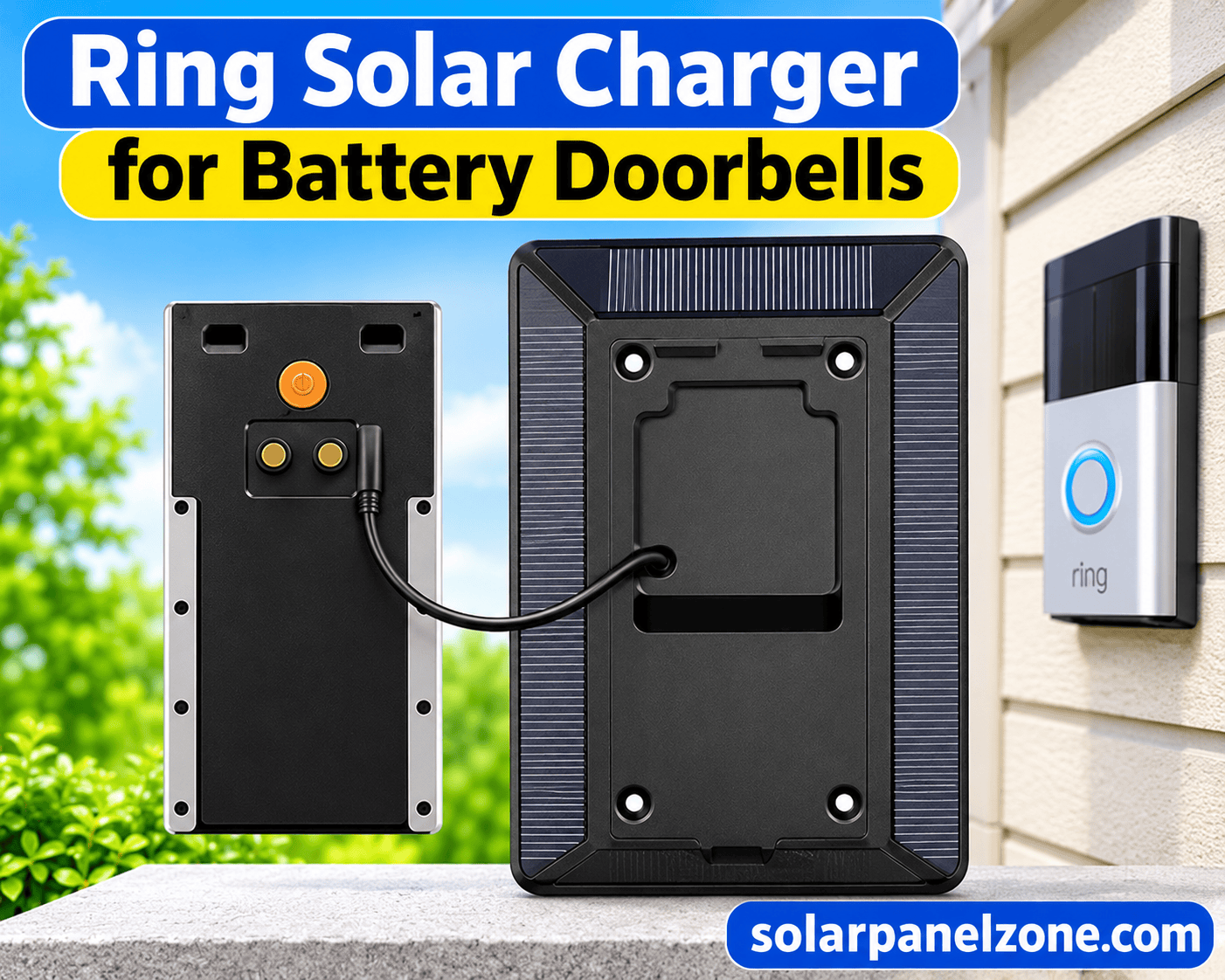
What Is the Ring Solar Charger for Battery Doorbells?
The Ring Solar Charger for Battery Doorbells is a weather-resistant Ring Solar Charger for Battery panel that trickle-charges a compatible Ring Solar Charger for Battery doorbell. It mounts on the wall behind or beside the Ring Solar Charger for Battery and feeds a slow, steady charge into the battery, so you pull the battery out for recharging less often.
It doesn’t turn aRing Solar Charger for Battery Doorbells into a wired one, and it doesn’t charge quickly. Think of it as a way to stretch the gap between manual charges, not to eliminate charging in every home.
Ring says the latest generation keeps the Ring Solar Charger for Battery Doorbells charged up to 35% longer than earlier solar chargers, and it includes a mounting bracket with built-in, weather-resistant solar panels. ring
You’ll also see it called the Ring Solar Charger (2nd Gen), the Ring doorbell solar panel, or simply the Ring Solar Charger for Battery Doorbells solar charger. They all refer to the same family of accessories, with different connectors for different doorbells.
Why People Buy It
The appeal is simple. Ring Solar Charger for Battery Doorbells doorbells are easy to install because there’s no wiring, but the trade-off is periodic recharging. Every few weeks or months, depending on how many motion events and live views the Ring Solar Charger for Battery Doorbells handles, you take the battery off, charge it indoors and put it back.
For many owners, the real annoyance isn’t the effort. It’s the gap in coverage while the Ring Solar Charger for Battery Doorbells is out, and the risk of forgetting to charge it at all.
A solar charger promises to keep the Ring Solar Charger for Battery Doorbells topped up from daylight alone. That’s attractive for renters who can’t hardwire a Ring Solar Charger for Battery Doorbells, for anyone with a hard-to-reach mount, and for busy entrances where the Ring Solar Charger for Battery Doorbells drains quickly.
Which Ring Solar Charger for Battery Doorbells Does It Work With?
This is the most important section, because compatibility is where most buyers go wrong. Ring Solar Charger for Battery Doorbells makes more than one solar charger, and the connector has to match your Ring Solar Charger for Battery Doorbells.
| Charger version | Connector | Works with |
|---|---|---|
| Fork-style (2nd Gen) | Fork connector attaches to terminal screws | Video Doorbell 3, Video Doorbell 3 Plus, Video Doorbell 4, Battery Doorbell Plus, Battery Doorbell Pro |
| USB-C version | USB-C cable | Battery Video Doorbell models with a USB-C port |
| Micro-USB version | Micro-USB cable | Video Ring Solar Charger for Battery Doorbells (2nd Gen) reach |
The fork-style charger isn’t compatible with Video Ring Solar Charger for Battery Doorbells 2 or other Ring doorbells that use a micro-USB connector. reach
Fork-style vs. USB-C vs. micro-USB
The easiest way to tell which you need is to look at how your Ring Solar Charger for Battery Doorbells takes power.
A fork-style charger attaches to the terminal screws on the back of the Ring Solar Charger for Battery Doorbells Plus. Chargers with a USB cable plug into doorbells that have a built-in Ring Solar Charger for Battery Doorbells. Those designs aren’t interchangeable. bestbuy
If you’re unsure, check your doorbell’s model name in the Ring Solar Charger for Battery Doorbells app, then match it against the table above. Check this before you buy, because reviewers who ended up with the wrong version describe it as the main reason for a “doesn’t work” verdict. One buyer notes it isn’t for older Ring doorbells because it uses USB-C. bestbuy
How It Actually Charges Your Ring Solar Charger for Battery Doorbells
The panel is small, and so is its output. Best Buy’s product Q&A puts the maximum power of the USB-C version at 0.75 watts. One reviewer describes a 0.57 W unit. bestbuy
That sounds weak, but the Ring Solar Charger for Battery Doorbells appetite is small too. One reviewer estimated that a 33 Wh Ring battery lasting about three months uses only around 0.3 Wh per day. Treat this as a back-of-the-envelope figure, not a Ring Solar Charger for Battery Doorbells specification. The point is that a trickle of sunlight can, in the right conditions, roughly offset daily drain. desertcart
Why it’s a “drip” Ring Solar Charger for Battery Doorbells
Because the panel produces so little power, Ring Solar Charger for Battery Doorbells is gradual. One reviewer describes it as drip charging, with a doorbell rising from 18% to 75% over about three weeks. Another reported going from 30% to 50% in two sunny days. These are personal experiences, not guarantees, and results depend on sunlight, season and how busy your doorbell is. desertcartdesertcart
The optimized charging catch
Some Ring doorbells stop Ring Solar Charger for Battery Doorbells at a set limit to protect battery health. One reviewer says that if the battery is already full when the solar charger is installed, the panel may appear to do nothing until the battery drops. This is based on a single review, so check Ring’s own documentation for your model. desertcart
The practical takeaway: a charger that “isn’t doing anything” on a full battery may be working as designed. Judge it over a couple of weeks, not a single afternoon.
How Much Sun Does It Need?
Direct sun matters more than brightness. A retailer listing for the charger advises installing it where it gets at least 3–4 hours of direct sunlight per day, without obstruction. aucklandairport
Use these rules when choosing the spot:
- Face the sun. In the Northern Hemisphere that usually means a south-facing wall. In the Southern Hemisphere, aim for north.
- Avoid shade. Porch roofs, trees, pillars and neighbouring buildings can cut output sharply.
- Watch the seasons. Low winter sun may miss a sheltered door entirely, even if summer is fine.
- Keep the panel clean. Dust, pollen and bird droppings reduce output.
Wedge and corner kits
If your door faces the wrong way, an angled mount can help. Ring recommends using only one Wedge Kit or Corner Kit with the solar charger. Don’t stack mounts to chase more angle, because that can leave the doorbell unstable. aucklandairport
Does It Really Work? An Honest Look
The short version: it works well for some homes and disappoints others. Reviews are genuinely mixed, and the differences usually come down to sunlight and expectations.
On the positive side, one owner says that since adding the 2nd generation charger they haven’t had to worry about the battery. Others say it removed the need to take the battery out and recharge it. desertcartbestbuy
On the negative side, the complaints cluster around a few themes:
- Seasonal drop-off. One reviewer says it charged fine during long summer days but not in autumn and winter. Another, in the UAE, reports that summer kept the battery topped up but winter, despite reasonable sunlight, left it nearly useless. desertcartdesertcart
- Extreme cold. One reviewer reports the charger stopped working during a polar vortex and later resumed. That’s one report, not a verified cold-weather limit. desertcart
- Low expectations vs. reality. One reviewer revised their verdict to say it keeps the battery steady or adds about 1% a week. That’s maintenance, not a recharge. desertcart
- Wrong-model purchases. Compatibility mix-ups drive a share of negative reviews.
Support experiences also show up. Several reviewers say Ring’s customer service reached out and helped resolve problems, though that’s anecdotal.
A realistic way to think about it
If your doorbell sees light traffic and your door gets several hours of direct sun, the charger can plausibly keep it topped up for long stretches. If your door is shaded, or the doorbell fires dozens of events a day, expect it to slow the drain rather than stop it.
How to Install the Fork-Style Charger
- Confirm your doorbell model and that it takes the fork-style connector.
- Remove the doorbell from its existing mounting plate.
- Fix the charger’s bracket to the wall or door frame using the included hardware.
- Connect the fork connector to the terminal screws on the back of the doorbell.
- Attach the doorbell to the bracket and check it sits firmly.
- Monitor the battery in the Ring app for a week or two before judging performance.
For the USB-C version, the cable plugs into the doorbell’s port, and built-in cable management keeps the run tidy. Always follow Ring’s mounting guidance, and don’t modify connectors or the battery.
Price Around the World
Prices vary by retailer, region and version. These are listings seen in late 2026, so check current prices before buying.
| Region | Version | Listed price |
|---|---|---|
| United States | Fork-style | $44.99 ($39.99 at one Walmart listing) |
| Europe | USB-C | €59.99 |
| New Zealand | Fork-style | NZ$69 including GST at PB Tech |
| South Africa | Fork-style | R 999 |
| Saudi Arabia | Fork-style | 179 SR solar charger for video doorbell 3 +5 |
Availability and versions differ by country. If you’re importing, check warranty terms and returns, since these differ from market to market. Sunlight differs by region too, so a gadget that works in a sunny climate can disappoint where winters are dark.
Pros and Cons
Pros
- Less frequent battery removal and recharging
- No wiring needed
- Includes a mounting bracket and weather-resistant panels
- Relatively inexpensive next to the doorbell itself
- Can pair with an angled mount to improve sun exposure
Cons
- Low power output means slow charging
- Needs several hours of direct sun
- Winter and cold-weather performance can disappoint
- Connector versions cause compatibility mistakes
- Adds bulk to the doorbell
Solar Charger vs. Spare Battery vs. Wired Power
| Option | Best for | Trade-off |
|---|---|---|
| Solar charger | Sunny doors, light to moderate traffic | Slow; weather- and season-dependent |
| Spare battery | Quick swaps with no downtime | Still manual recharging |
| Wired power | Doors with existing doorbell wiring | Needs installation; not always possible for renters |
| Third-party solar mount | Different designs or fits | Wasserstein’s mount lists compatibility with Video Doorbell 3, 3 Plus, 4 and Battery Doorbell Plus and Pro, but check reviews, warranty and fit carefully walmart |
Third-party options exist, but quality varies. Reviews of some third-party mounts mention fit and charging complaints alongside happy owners, so read recent feedback first.
Who Should Buy It, and Who Should Skip It
Buy it if:
- Your door gets 3–4+ hours of direct sun
- Traffic at the door is light to moderate
- You want to cut down on recharging without wiring
Skip it if:
- Your doorbell sits in deep shade or under a deep porch
- Your winters are long and dark
- Your doorbell triggers constantly
- You can wire the doorbell to existing doorbell wiring
A quick scenario: Priya’s front door faces south with a clear view of the sky. Her doorbell logs a handful of events a day. A solar charger is a sensible buy. Marcus’s door faces north under a deep porch roof. For him, a spare battery or a wired setup will likely save frustration.
Troubleshooting Checklist
If the charger doesn’t seem to be working:
- Confirm the connector matches your doorbell
- Check that the connection is seated firmly
- Look for shade at different times of day
- Clean the panel
- Remember a near-full battery may not charge, so wait a week or two
- Watch the trend in the Ring app rather than a single reading
- Consider a wedge or corner kit to improve the angle
- Contact Ring support if it still isn’t charging
Safety and Care
Don’t open, drill or modify the charger, connector or battery. Mount it securely so the doorbell can’t fall. If you’re considering a wired alternative, follow your local electrical rules or hire a qualified electrician.
Frequently Asked Questions
Does the Ring solar charger actually work?
For many homes, yes, but results depend on sunlight, season and doorbell traffic. Owners report anything from “never recharged again” to “barely holds steady,” so match it to your conditions.
Which Ring doorbells work with it?
The fork-style version fits Video Doorbell 3, 3 Plus, 4, and Battery Doorbell Plus and Pro. USB-C and micro-USB versions cover other models. Match the connector first.
How much sun does it need?
Retail listings advise at least 3–4 hours of direct, unobstructed sunlight per day. Shade and low winter sun can reduce results.
Does it work on cloudy days or in winter?
It can add some charge in diffuse light, but output drops. Several reviewers report weaker performance in autumn and winter, even in sunny regions.
How long does it take to charge the doorbell?
It’s a slow trickle charger. Reviewers report anything from a few percent a week to roughly 20% a day in good sun, so judge it over weeks.
Is it waterproof?
Ring describes the panels as weather-resistant. Check the product page for specific ratings before relying on a particular level of protection.
Can I use it with Video Doorbell 2?
Not the fork-style version. Video Doorbell 2 uses a micro-USB connector and needs the matching charger.
Does it come with a mount?
Yes. Ring lists a mounting bracket with built-in panels, and angled wedge or corner kits can be added.
How much does it cost?
About $44.99 in the US, and higher in other markets once taxes, shipping and version differences are included.
Conclusion
The Ring Solar Charger for Battery Doorbells is a practical, inexpensive way to reduce recharging, provided three things line up: the right connector, enough direct sun, and realistic expectations. It supplements your battery rather than replacing manual charging.
Before you buy, confirm your doorbell model, watch your door’s sunlight for a day, and check the return policy. After installing, give it a week or two and track the battery in the Ring app. If your door is shaded or winters are dark, a spare battery or wired power is likely the better choice.
Unfulfilled Points: The “390” modifier is unverified and was left out. Ring’s official statements on optimized charging, cold-weather behavior and the product’s weatherproof rating weren’t confirmed, so those are described as reviewer reports or general descriptions. Live SERP data and keyword volumes weren’t available.
These information about solar panel mounting are gathered from different surveys, medical tests and tech giants like Tom’s Guide and more. Our top priority is to provide you valuable information.
For More Details About Different Solar Panels Click Here