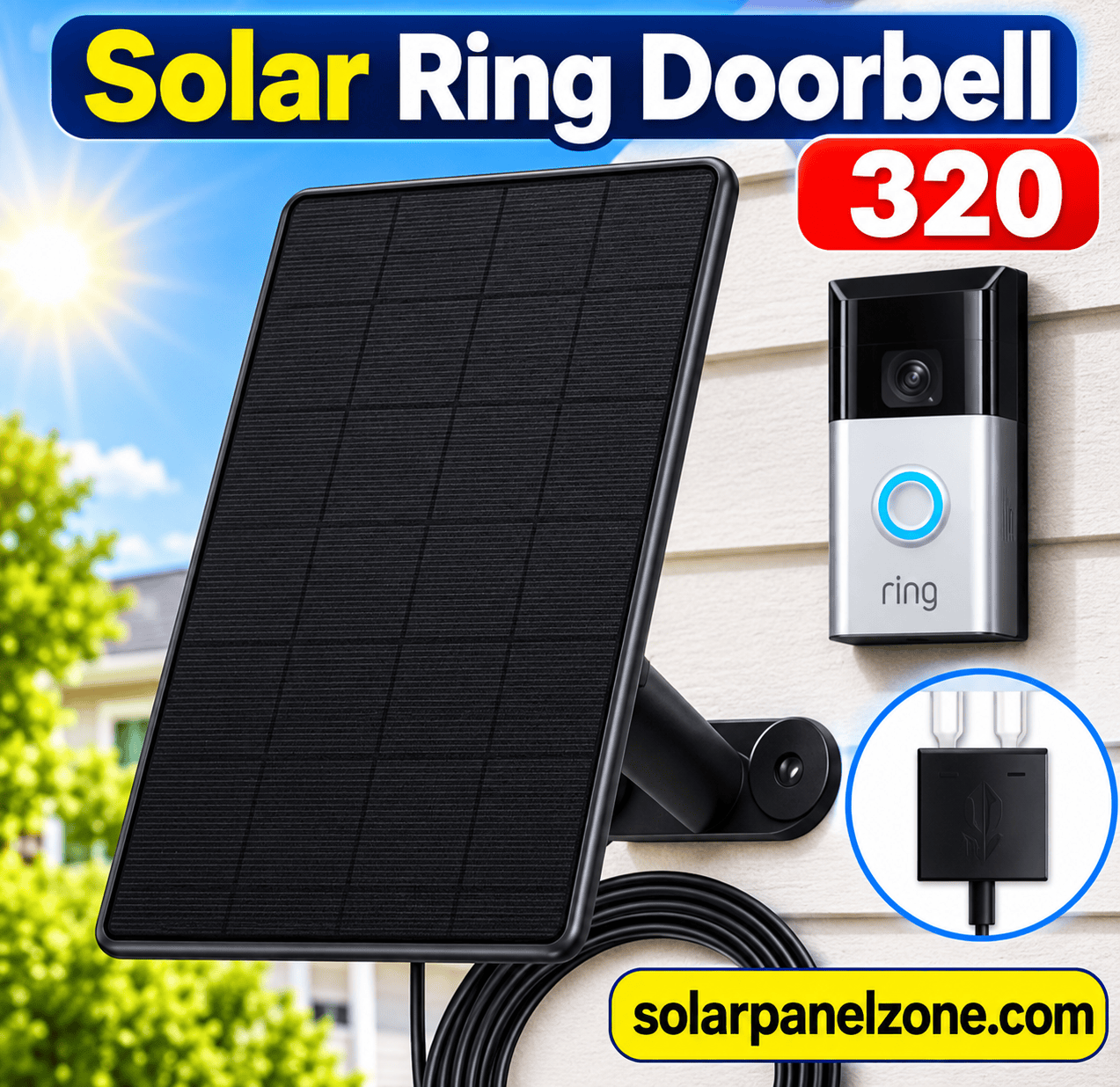
Does Ring Make a Solar Doorbell?
Short answer: Ring sells solar panels and solar chargers that keep compatible battery Solar Ring Doorbell 320 topped up. They are accessories, not built-in power. Each needs roughly three to four hours of direct sunlight daily, and the right one depends on your Solar Ring Doorbell 320 generation.
If you landed here after searching “solar ring doorbell 320”, you are in the right place. The goal is the same either way: stop pulling the battery out every few weeks, and buy the correct part the first time.
This guide shows which accessory fits which Solar Ring Doorbell 320, whether your porch gets enough sun, what the parts cost, and when solar is the wrong answer.
What “Solar Ring Doorbell 320” Usually Means
Solar Ring Doorbell 320 does not list a product with Solar Ring Doorbell 320 in its name. The number most likely comes from one of three places: a fragment of a model code on a box or marketplace listing, a price in your local currency, or a guess at wattage.
Wattage is worth a note, because solar listings can mislead. A retailer listing for a Solar Ring Doorbell 320 solar charger shows a rating of about 0.57 W, and an older Solar Ring Doorbell 320 charger lists 0.56 W. These are trickle chargers, not power stations.
So ignore the number and identify your Solar Ring Doorbell 320 instead. Open the Solar Ring Doorbell 320 app, go to Device Health, and note the model name. The back label on the Solar Ring Doorbell 320 shows it too.
Solar Panel vs. Solar Charger: Two Ways to Add Solar
Solar Ring Doorbell 320 offers two designs. They solve different placement problems.
The solar panel (on a cable)
A small outdoor panel on a long cable that you mount wherever the sun hits. Solar Ring Doorbell 320 listings show a cable of about 6 m (roughly 20 ft) and a panel around 20 cm wide. It has an adjustable bracket and a weather-resistant build.
This suits doors in shade. You can place the panel on a sunnier wall or roof edge and run the cable back to the Solar Ring Doorbell 320.
The solar charger (mount-behind)
A bracket with built-in solar cells that sits behind the Solar Ring Doorbell 320. It uses the same wall holes as the Solar Ring Doorbell 320 so no extra bracket is needed, and Solar Ring Doorbell 320 says no in-app setup is required.
This suits Solar Ring Doorbell 320 that already sit in direct sun. It has no long cable to hide.
| Solar panel | Solar charger | |
|---|---|---|
| Placement | Anywhere with sun, within cable reach | Directly behind the Solar Ring Doorbell 320 |
| Best for | Shaded Solar Ring Doorbell 320, sunny nearby wall | Solar Ring Doorbell 320 in direct sun |
| Cable | About 6 m | Short, hidden behind the unit |
| Covered porch | Workable if the panel sits in sun elsewhere | Not ideal, says Solar Ring Doorbell 320 |
Which Ring Solar Accessory Fits Your Doorbell?
Short answer: Match by generation and connector. Older Solar Ring Doorbell 320 use a fork connector or micro-USB, and some newer battery doorbells use a USB-C adapter with a fork connector. Parts for one generation often do not fit another.
The table below pulls together what Ring’s support and product pages show. Names differ by region, so confirm on Ring’s page for your country before ordering.
| Your doorbell | Solar option | Connector |
|---|---|---|
| Video Doorbell (2nd Gen) | Dedicated solar panel | Micro-USB |
| Video Doorbell 2, 3, 3 Plus, 4 | Solar Panel for Doorbells | Fork connector |
| Battery Video Doorbell Plus / Pro | Solar Panel for Doorbells | Fork connector |
| Battery Video Doorbell Plus (2nd Gen) | Panel version with USB-C adapter and fork connector | USB-C / fork |
| Battery Doorbell, Plus, Pro (newest 2nd Gen line) | Newer Solar Panel or Solar Charger for battery doorbells | Fork or USB-C, by model |
| Original Ring Video Doorbell | Older bracket-style charger | Bracket |
Two cautions apply. Ring’s support page lists the chargers for Video Doorbell 2 and the 1st Gen as discontinued, so any you find may be leftover or third-party stock.
Also, the same retailer pages that sell a USB-C battery-doorbell charger state it will not work with Video Doorbell 2, 3, 3 Plus, 4 or the earlier Plus and Pro models. Read the compatibility line, not only the product photo.
Don’t confuse these with Spotlight Cam and Stick Up Cam panels
Ring sells solar panels for its Spotlight Cam and Stick Up Cam too. Those are different products. A review site notes Ring’s solar versions of those cameras are priced separately, so make sure the listing says “doorbell”.
Wedge kits and corner kits
The doorbell solar panel is compatible with Ring’s Wedge Kits and Corner Kits. A listing for the mount-behind charger says it works with one such kit for Video Doorbell 3, 3 Plus or 4, and Ring suggests using only one kit at a time.
How Much Sun Does a Ring Solar Panel Need?
Short answer: Ring says its solar devices need three to four hours of direct sunlight a day. Light filtered by cloud, glass or indoor lamps does not provide a useful charge.
Direct means the sun actually reaches the cells. A bright, overcast day is not the same thing.
Ring’s FAQ also warns about shade. An extended roof, trees or bushes can cast shadows on the panel for much of the day, even when the sky is clear.
Direction and placement
- Northern hemisphere: face the panel or charger south.
- Southern hemisphere: face it north.
- Covered porches: Ring says chargers are not ideal there.
- Indoors: not recommended, since indoor light is too weak.
What this means by region
| Climate | Typical outcome |
|---|---|
| Desert and Gulf regions (for example UAE, Arizona) | Strong sun, but clean dust off the panel regularly |
| Sunny mid-latitude (Australia, southern Europe, much of South Asia) | Good results on unshaded, correctly facing spots |
| Cloudy, high-latitude (UK, Pacific Northwest, Northern Europe) | Weaker, especially in winter when days are short |
This table is directional. Your own roofline and trees matter more than your country.
What Solar Charging Actually Does to Your Battery
Solar here is a trickle charge. It offsets daily drain; it does not turn the doorbell into a mains-powered one.
Two behaviours surprise people:
- The 90% rule. Ring says that once a battery is above 90%, it will not take a new charge. Below that, it will.
- Device Health still says battery. The Ring app keeps showing the power source as a battery even with solar connected. That is normal.
Reviewer experiences vary widely, which is why opinions look so split. One reviewer with limited sun reported roughly 20% added per day on a Battery Doorbell Pro and noted some doorbells use an optimized charging limit near 80%. Another, whose front door gets six hours or more of sun, said the battery has stayed above 80% for months. These are individual reports, not guarantees.
Your settings matter too. Frequent motion alerts and long live views drain the battery faster than a small panel can replace.
Is a Ring Solar Charger Worth It?
| Pros | Cons |
|---|---|
| Fewer manual recharges | Needs direct sun, not just daylight |
| No wiring | Low wattage; busy doorbells can outpace it |
| Weather-resistant, official fit | Generation-specific; wrong-part returns are common |
| Charger version needs no extra bracket | Cannot connect to an existing chime |
Who should skip solar
- Doors on a deep covered porch with no sunny wall nearby.
- Households with very high motion activity, such as a busy street.
- Homes with existing doorbell wiring, where hardwiring is simpler.
- Anyone expecting solar to power a chime. Ring says it cannot.
- Renters who cannot mount a panel or run a cable.
What It Costs
Prices move, so treat these as examples seen on Ring’s regional pages and check the live listing.
| Region | Example price |
|---|---|
| United Kingdom | £49 (Solar Panel for Doorbells) |
| Europe | 59 € (same panel family) |
| United States | $47.99, listed down from $59.99 (newer battery-doorbell panel) |
Third-party chargers are often cheaper, but read the reviews first. In retailer review threads, some buyers of third-party units reported they did not charge at all, and one said Ring declined to help because the part was not Ring’s. Treat that as one buyer’s account, but it is a reason to check warranty terms before buying.
How to Install a Ring Solar Panel or Charger
- Fully charge the doorbell battery first. Ring recommends this for the mount-behind charger.
- Pick the spot. Look for three to four hours of direct sun and no shadows from roofs, trees or bushes.
- Mount the panel or charger. The panel uses its adjustable bracket. The charger uses the doorbell’s existing screw holes.
- Route the cable (panel only). Run it to the doorbell, using the wire spacer where supplied.
- Connect. Use the fork connector, USB-C adapter or micro-USB, as your model requires.
- Seat the doorbell and confirm it is secure.
- Check in the Ring app. Watch the battery level over the next sunny days.
A screwdriver, drill, supplied anchors, a level and cable clips cover most installs.
Troubleshooting a Solar Charger That Isn’t Charging
Start with the simple causes before blaming the hardware.
- Wrong part. Recheck the connector and generation match.
- Not enough direct sun. Observe the spot through a full day. Shadows move.
- Battery above 90%. No charge is expected until it drops.
- Cloudy stretch or winter. Output falls; Ring notes charging resumes when direct sun returns.
- Dirty cells. Dust, pollen and bird droppings reduce output.
- Loose connection. Reseat the connector and check the cable for damage.
- Cold weather. Batteries lose capacity in the cold, so a drain-heavy winter can beat a small panel. One reviewer returned a unit after their doorbell stopped working in freezing temperatures.
Ring’s support site has troubleshooting pages for both the Solar Charger and the Solar Panel if the basics do not fix it.
Alternatives to Solar
| Option | Best for | Trade-off |
|---|---|---|
| Hardwire to a doorbell transformer | Homes with existing wiring | Installation effort |
| Spare battery rotation | Shaded doors, renters | Manual swaps |
| Lower motion sensitivity and shorter clips | Moderate sun | Fewer recorded events |
| Another doorbell with built-in solar | Starting from scratch | Switching ecosystems |
If your door fails the sun test, hardwiring is usually the more reliable path than a larger solar setup.
Mounting, Safety and Privacy
These accessories are for outdoor use only. Fix the bracket firmly into sound masonry or frame, keep cables clear of walkways, and do not hang the panel from the cable.
Doorbell cameras can capture neighbours’ property or public space. Rules differ by country, so check local guidance on camera placement and recording signage.
FAQs
What is the solar Ring doorbell 320? Ring lists no product by that name. It is most likely a model-code fragment, a price or a wattage guess. Check your doorbell’s model in the Ring app and match it to Ring’s compatibility list.
How many hours of sun does a Ring solar panel need? Ring says three to four hours of direct sunlight a day, depending on usage. Shade and cloud reduce results.
Can I connect a Ring solar panel to my chime? No. Ring’s FAQ says the panel cannot connect to a mechanical or digital chime.
Does Ring solar work on cloudy days? Poorly. Light filtered through cloud does not charge the way direct sun does, though charging resumes when the sun returns.
Why is my battery stuck below 100%? Above about 90% the battery stops accepting new charge, and some models use an optimized limit near 80%.
Can I mount the panel on a roof? Ring says the panel can go on a wall or roof that receives direct sunlight, as long as the cable reaches your doorbell and the mount is secure.
Which colour should I choose? Panels are sold in black and white on some regional pages. Colour does not affect charging, so match your exterior.
Is a third-party solar charger okay? Some work, but reviews are mixed and compatibility errors are common. Confirm the exact doorbell model and the seller’s return and warranty terms.
Conclusion
Solar can cut the number of times you take your Ring battery down, but only if three things line up: the right part for your generation, three to four hours of direct sun, and settings that do not drain the battery faster than the panel refills it.
Start by confirming your model in the Ring app. Match it to the compatibility table, test your sun for a full day, then choose a panel for shaded doors or a mount-behind charger for sunny ones. If the sun test fails, wiring the doorbell is the safer bet.
Unfulfilled Points: Hands-on test data, seasonal measurements and an author bio could not be included because I have not tested these products. A confirmed weather-resistance (IP) rating was not available in the sources, so none is stated.
These information about solar panel mounting are gathered from different surveys, medical tests and tech giants like Tom’s Guide and more. Our top priority is to provide you valuable information.
For More Details About Different Solar Panels Click Here