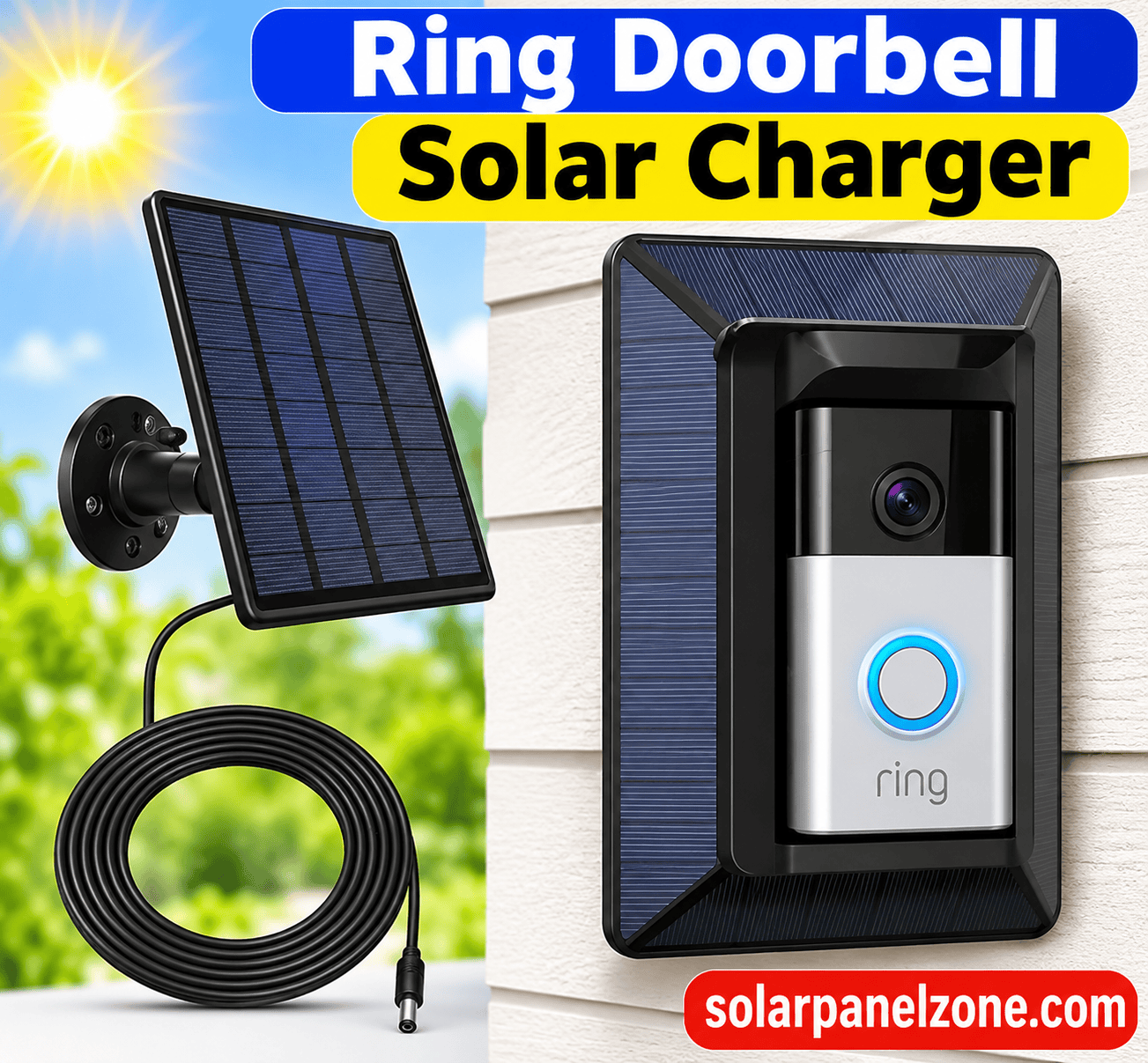
Ring Doorbell Solar Charger: Which One Fits Your Model
A Ring solar charger only works if it matches your doorbell’s connector. Battery Ring Doorbell Solar Charger models use USB-C, Plus and most Video Ring Doorbell Solar Charger 3 and 4 models use a fork-style connector, and the 2nd Gen uses micro-USB. With three to four hours of direct sun daily, it trickle-charges the battery.
That is the short version. The rest of this guide helps you pick the right charger, install it properly and decide whether Ring Doorbell Solar Charger is worth it at your front door.
What Is a Ring Doorbell Solar Charger?
A Ring Doorbell solar charger is a small weather-resistant solar panel that mounts behind or beside a battery-powered Ring Doorbell Solar Charge. It feeds the battery a slow, steady trickle charge, so you recharge less often.
The key word is trickle. It does not charge your battery the way a wall adapter does. It offsets the power your Ring Doorbell Solar Charger uses each day.
If your Ring Doorbell Solar Charger wakes up a few times a day, that offset can be enough to keep the battery topped up. If it wakes up dozens of times, solar may only slow the drain.
Which Ring Doorbell Solar Charger Work With Solar?
Compatibility is where most people go wrong. Ring Doorbell Solar Charger has released several chargers over the years, and each fits a different doorbell generation through a different connector.
The table below follows Ring Doorbell Solar Charger compatibility information. Ring Doorbell Solar Charger lineup changes, so confirm your exact model name in the Ring Doorbell Solar Charger app and on Ring’s compatibility page before you buy.
| Your doorbell | Charger type | Connector | Notes |
|---|---|---|---|
| Ring Battery Doorbell (2024 release) | Solar Charger for Ring Battery Doorbell | USB-C | Not for Plus or Pro models |
| Ring Battery Doorbell Plus | Solar Charger for Battery Doorbells (2nd Generation) | Fork | Attaches to the terminal screws on the back |
| Ring Battery Doorbell Pro | Fork-style charger per retailer listings | Fork | Ring Doorbell Solar Charger regional support pages list Pro as supported; verify before buying |
| Ring Doorbell Solar Charger Video Doorbell 3 and 3 Plus | Solar Charger for Battery Doorbells (2nd Generation) | Fork | Has its own specific charger |
| Ring Video Doorbell 4 | Solar Charger for Battery Doorbells (2nd Generation) | Fork | Works with Ring Doorbell Solar Charger Wedge or Corner Kit |
| Ring Video Doorbell (2nd Gen, 2020) | Solar Charger for Battery Doorbells | Micro-USB | Check current availability |
| Ring Doorbell Solar Charger 2 | Older charger | Varies | Ring Doorbell Solar Charger says its dedicated charger is discontinued |
| Ring Doorbell Solar Charger Video Doorbell (1st Gen) | None | n/a | Charger discontinued; USB-C model will not fit |
Quick test: Open the Ring Doorbell Solar Charger app, go to your doorbell’s Device Health and note the exact model name. Then match the name, not the look of the Ring Doorbell Solar Charger.
Why the Connector Matters
The USB-C charger will not fit a Plus or Pro. The fork-style charger will not plug into a USB-C Battery Ring Doorbell Solar Charger. A mismatch means a return, not a workaround.
Wired Ring Doorbell Solar Charger such as Wired Doorbell Plus and Pro get power from a transformer, so solar charging does not apply to them.
How Ring Doorbell Solar Charger Works
Sunlight hits the photovoltaic cells and becomes electricity. Built-in circuitry limits what flows to the doorbell’s lithium-ion battery.
Ring Doorbell Solar Charger says its chargers need roughly three to four hours of direct sunlight a day to extend battery life. Bright shade is not the same thing.
Output varies with season, angle, weather and dirt on the panel. One retailer listing for the USB-C charger states a maximum power delivery of 0.75 watts. That is modest, which is why placement matters more than most buyers expect.
For the fork-style generation, a retailer listing claims up to 35% longer charge compared with earlier solar charger generations. Treat that as a manufacturer comparison, not a promise for your porch.
Types of Solar Options
Official Ring Solar Chargers
These are built for specific Ring doorbells and come with a mounting bracket. Retail listings show about $49.99 in the US and £49.99 in the UK for the standard Battery Doorbell charger. Fork-style versions are often priced higher, so check current prices.
A retailer listing for the USB-C model mentions a one-year limited warranty. Confirm warranty terms where you buy.
Third-Party Solar Panels
Brands such as Wasserstein sell panels aimed at several Ring models. One universal listing describes a 2.5W flexible panel with both USB-C and micro-USB connectors, and says it also supports a Wyze doorbell.
Third-party panels can offer more wattage for the money. They also put the compatibility checking on you.
Solar Panels for Ring Cameras
Ring also sells a separate 2.4W solar panel with a barrel connector for its Outdoor Cam. It is not a doorbell charger, so do not buy it for a doorbell.
Official vs Third-Party: Which Should You Buy?
| Factor | Official Ring charger | Third-party panel |
|---|---|---|
| Compatibility certainty | High for listed models | Depends on connector and listing accuracy |
| Setup | Bracket and cable included | Varies; may need extra mounting work |
| Weather resistance | Weather-resistant built-in panel | Check the stated IP rating |
| Power output | Modest | Some offer higher wattage |
| Support | Ring warranty and support | Seller’s warranty |
| Battery risk | Low | Higher with poorly regulated products |
The safer choice for most people is the official charger. It removes the guesswork about voltage and fit.
A third-party panel makes sense if you have a sunny, exposed spot, you understand the connector, and the seller has a clear return policy and a stated weatherproof rating.
Avoid unbranded panels with no wattage, no rating and no return terms. A lithium-ion battery is not the place to gamble.
Will Solar Actually Work at Your House?
This is the question that matters most, and it comes down to a few honest checks.
Check Your Sun
Watch your doorbell location for a day. Count the hours that direct sun actually reaches the spot, not the hours it is bright outside.
- Three to four hours or more: solar is likely to help.
- One to two hours: expect a slower drain, not a fix.
- Almost none: skip solar and look at the alternatives below.
Check Your Direction
Ring advises facing the charger south in the Northern Hemisphere and north in the Southern Hemisphere. That aims the panel along the sun’s path.
Check Your Season
High-latitude homes see shorter, lower-angle winter sun. Snow can cover the panel. Dust, pollen and bird droppings reduce output at any time of year.
In sunny regions the opposite problem appears: heat. Keep the panel in sun but avoid trapping heat around the doorbell itself.
Check Your Traffic
A doorbell facing a busy road triggers motion constantly. Each event uses power. In that case solar helps, but it may not be enough on its own.
How to Install a Ring Solar Charger
Most installs take 15 to 30 minutes. Ring’s guidance is to fully charge the doorbell battery before you install it.
- Confirm the model. Match your doorbell to the right charger and connector.
- Pick the spot. Choose a location with the most direct sun and a clear view toward the equator.
- Attach the bracket. Secure the mounting bracket to the charger with the supplied screws.
- Mount the unit. Many Ring chargers can use the doorbell’s existing drill holes, so there may be no new drilling. Otherwise use the included wall anchors and screws.
- Connect the cable. Plug the USB-C or micro-USB cable into the doorbell, or attach the fork connector to the terminals on the back of the Plus.
- Seat the doorbell. Fit the doorbell onto the charger or bracket.
- Check the app. Watch the battery level over the next several days.
Wedge and corner kits: If you use an angle kit to aim the doorbell, Ring recommends using only one Wedge or Corner Kit with the solar charger.
No in-app setup is required, according to Ring’s support information. The charger simply feeds the battery.
Solar Charger Not Charging? Troubleshooting
If your battery keeps dropping, work through these in order.
- Wrong charger: Re-check the connector against your exact model.
- Poor connection: Reseat the cable or fork connector and make sure it is snug.
- Not enough sun: Observe the panel through the day. Trees and eaves cause more trouble than people expect.
- Dirty panel: Wipe it with a soft damp cloth.
- Heavy use: Reduce Motion Zones, lower motion frequency and limit constant Live View.
- Weak Wi-Fi: A poor signal makes the doorbell work harder and drain faster.
- Old battery: Batteries lose capacity over time.
Ring also publishes dedicated troubleshooting steps for its solar chargers and panels. If basics fail, start there or contact support.
Safety and Battery Care
Treat the battery with respect. Do not open, bend or modify it, and do not bypass the charging circuitry.
For third-party panels, only use products that state a compatible output and include basic protection. If the battery swells, overheats or smells odd, stop using it and contact the manufacturer.
Alternatives If Solar Isn’t Enough
Solar is one way to cut battery chores. It is not the only one.
| Alternative | Best for | Trade-off |
|---|---|---|
| Spare Quick Release Battery Pack | Shady entrances | You still swap batteries manually |
| Hardwiring with a transformer | Homes with existing doorbell wiring | Needs wiring; some models use a Din Rail Transformer |
| Lower motion sensitivity | Busy streets | Fewer alerts |
| Switching to a wired model | Long-term reliability | Cost and installation |
If your doorbell sits in permanent shade, hardwiring or a spare battery is usually the better plan.
Is a Ring Solar Charger Worth It?
For many homes, yes. It is worth it when your doorbell gets several hours of direct sun, your traffic is moderate, and you want fewer battery swaps without any wiring.
It is less worthwhile when the porch is shaded, winters are dark, or the doorbell fires all day. In those cases it softens the problem rather than solving it.
At around the price of a mid-range accessory, the downside is small if you buy the correct model and keep the return window in mind.
Pre-Purchase Checklist
- Exact Ring model name confirmed in the app
- Charger matches your connector (USB-C, fork or micro-USB)
- Three to four hours of direct sun at the mounting spot
- Panel can face south (or north in the Southern Hemisphere)
- Warranty and return policy checked
- Spare battery or backup plan if sun is limited
Frequently Asked Questions
Does Ring make a solar charger for its video doorbells?
Yes. Ring sells solar chargers for several battery-powered doorbells, with different connectors depending on the model. Always match your doorbell to the correct version.
Which solar charger works with the Ring Battery Doorbell Plus?
The Battery Doorbell Plus uses the fork-style charger that attaches to the terminal screws on the back. The USB-C version is not compatible with the Plus.
Can I use any solar panel with a Ring doorbell?
Not safely. The panel needs the right connector and a suitable output. Some third-party panels list support for several Ring models, but check the listing carefully and prefer sellers with clear return terms.
How much sun does a Ring solar charger need?
Ring says roughly three to four hours of direct sunlight a day. Bright shade is not enough.
Does a Ring solar charger work in winter?
It works with reduced output. Short days, low sun, cloud and snow lower charging. Users in dark winters may still need occasional manual charging.
Is the Ring solar charger waterproof?
Ring’s chargers have weather-resistant built-in solar panels. For third-party panels, look for a stated IP rating rather than vague claims.
Will solar make my Ring doorbell battery last forever?
Not always. It extends the time between charges. Busy doorbells, weak Wi-Fi or poor sun can still drain the battery.
Do I need to set up the solar charger in the Ring app?
No in-app setup is required for Ring’s chargers. Use the app to watch battery level and charging behavior.
Is solar better than hardwiring a Ring doorbell?
Hardwiring is more reliable if you already have doorbell wiring. Solar suits renters and homes without wiring.
Conclusion
A Ring solar charger is a simple upgrade when it matches your doorbell and your porch gets real sun. Check your exact model first, match the connector, then place the panel where it catches direct light.
Your next steps:
- Find your doorbell’s model name in the Ring app.
- Match it to the right charger and connector in the table above.
- Spend a day watching the sun at your mounting spot.
- Choose the official charger for certainty or a reputable third-party panel for flexibility.
- Install it, then check battery trends for a week and adjust the angle if needed.
If the sun just isn’t there, a spare battery or hardwiring will serve you better.
Unfulfilled Points: Original charge-rate test data, photos and an author bio could not be included because they require first-hand testing and personal details not provided. Keyword volume figures were also unavailable.
These information about solar panel mounting are gathered from different surveys, medical tests and tech giants like Tom’s Guide and more. Our top priority is to provide you valuable information.
For More Details About Different Solar Panels Click Here