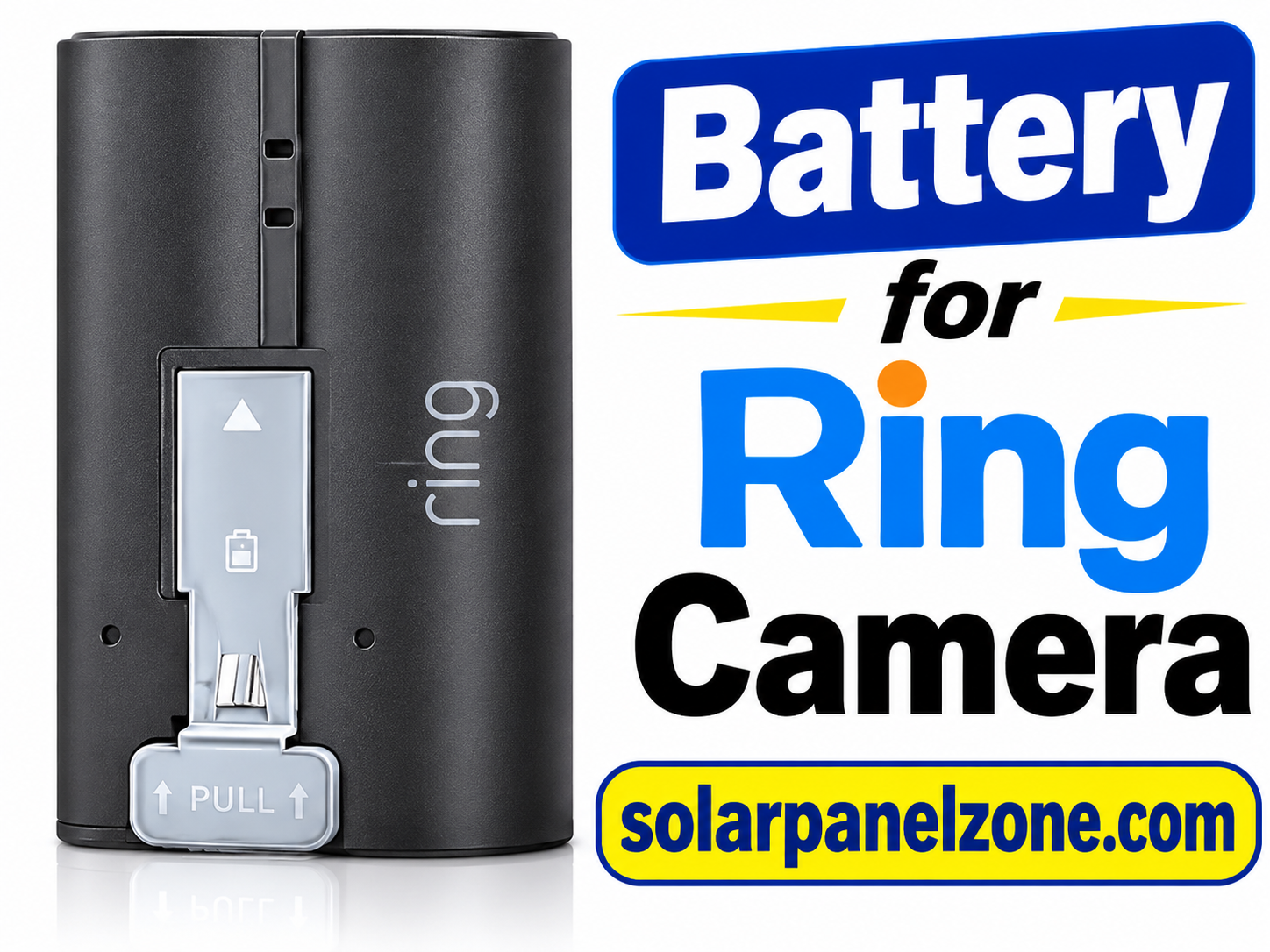
Battery for Ring Camera: Compatibility, Prices & Charging Guide
A Battery for Ring Camera that drops offline at the wrong moment is more than an annoyance. Usually the fix is simple: charge the Battery for Ring Camera or swap in a spare. The hard part is knowing which battery actually fits your Battery for Ring Camera.
Ring has renamed products, launched a higher-capacity pack, and changed charging connectors over the years. This guide covers what to buy, what it costs, how to charge and swap it, and when solar or wired power beats buying another battery.
What is the right Battery for Ring Camera for a Ring camera?
Short answer: Most Battery for Ring Camera-powered Ring cameras use Battery for Ring Camera Ring’s rechargeable lithium-ion Quick Release Battery for Ring Camera Pack. Newer models, such as the 2K-generation Spotlight Cam and Outdoor Cam, use the higher-capacity Quick Release Ultra Battery for Ring Camera Pack. Always check your exact model before buying.
Both packs are designed to slide into the Battery for Ring Camera and lock in place. To remove one, you press the quick-release tab, pull the pack out, and charge it. Many owners keep a second pack charged so a swap takes a minute and the Battery for Ring Camera is never down.
The two families look similar but are not interchangeable across every device. That is where most wrong purchases happen.
Which Ring cameras use which Battery for Ring Camera?
The table below maps common Battery for Ring Camera-powered devices to the pack and solar option that usually go with them. Battery for Ring Camera updates its lists as new models launch, so confirm your device in Ring’s official device compatibility list before checkout.
| Device | Battery pack | Solar panel option |
|---|---|---|
| Stick Up Cam Battery (2nd and 3rd Gen), now sold as Outdoor Cam | Quick Release Battery for Ring Camera Pack | Solar Panel with barrel plug, or a USB-C panel using the included adapter |
| Spotlight Cam Battery for Ring Camera | Quick Release Battery Pack | Same as above |
| Spotlight Cam Plus and Pro (battery) | Quick Release Battery Pack | USB-C Solar Panel |
| Stick Up Cam Pro (battery) | Quick Release Battery Pack | USB-C Solar Panel |
| Outdoor Cam Plus (battery) | Quick Release Battery Pack | USB-C Solar Panel |
| Peephole Cam | Quick Release Battery Pack | Not applicable |
| Video Doorbell 2, 3, 3 Plus, 4 | Quick Release Battery Pack | Ring Solar Charger (Doorbell 3, 3 Plus and 4) |
| Battery Video Doorbell Plus and Pro | Quick Release Battery Pack (earlier versions) | Check Ring’s list for your version |
| Newest-generation models: Spotlight Cam 2K, Outdoor Cam 2K, Peephole Cam 2K, Battery Doorbell 2K Plus and 4K Pro | Quick Release Ultra Battery Pack | Small Solar Panel (USB-C) on supported cameras |
Two cautions apply. Retailer listings and Ring’s own pages do not always agree on which devices accept which pack. One retailer Q&A, for example, says the Spotlight Cam Pro (2nd Gen) does not accept the Ultra pack even though other listings group it with the newest models.
When sources conflict, trust the model name in your Ring app and Battery for Ring Camera Ring’s current compatibility list over a third-party product page.
Ring’s renamed products can trip you up
Ring has relabeled several devices. Listings now note that the Stick Up Cam (2nd and 3rd Gen) is “Outdoor Battery for Ring Camera.” Labels such as “2K,” “4K,” and “Newest Model” mark newer hardware, and those are usually the ones that need the Ultra pack.
If you search for a Battery for Ring Camera using an old product name, you may land on a pack meant for a different generation.
How to confirm your exact model
- Open the Battery for Ring Camera app and find the device name on the camera’s tile or in its settings.
- Match that name to Ring’s device compatibility list.
- Check the retailer listing for the same name, not just “Battery for Ring Camera.”
- If a seller’s page says “fits all Ring cameras,” treat it with suspicion.
Standard vs Ultra Battery for Ring Camera Pack: what’s the difference?
Short answer: The Ultra pack holds more charge, with one retailer citing up to 67% more capacity. It charges over USB-C and is built for Ring’s newest devices. The standard pack covers a wider range of older devices, charges by Micro-USB, and works with Ring’s Charging Station.
| Standard Quick Release Battery Pack | Quick Release Ultra Battery Pack | |
|---|---|---|
| Best for | Older and widely installed Battery for Ring Camera devices | Newest-generation doorbells and cameras |
| Capacity | Baseline | Higher, up to 67% more per one retailer |
| Charging | Micro-USB cable or Ring Charging Station | USB-C cable |
| Charging Station | Compatible | Not compatible |
| Typical US price on Ring’s site | $34.99 | $49.99 |
Choose the standard pack if your camera’s compatibility list names it, or you want to charge several packs at once on a Charging Station.
Choose the Ultra pack if your device is a newest-generation model that requires it. Buying it for an older device usually does not help, because the device may not accept it.
How much does a Ring camera battery cost?
Prices vary by country, retailer, and promotion. These figures are from Battery for Ring Camera own store and major retailers, and they move often.
| Region | Pack | Observed price | Seller |
|---|---|---|---|
| United States | Standard | $34.99 | Ring |
| United States- | Ultra | $49.99 | Ring |
| United Kingdom | Ultra | £39.99 | EE |
| Australia | Standard | A$49 | JB Hi-Fi |
| Australia | Ultra | A$79 | JB Hi-Fi |
Some cameras ship in bundles that include an extra pack, which can be cheaper than buying a spare separately. If you run several cameras, compare bundle pricing before you add single packs to the cart.
Import and marketplace sellers sometimes list Ring packs in other regions. Check the connector type, the warranty terms, and the seller’s return policy before ordering.
Genuine battery-for-ring-camera vs third-party battery
Third-party packs are cheap and plentiful. One listing offers a replacement pack for under $8 and claims 6040 mAh of capacity. Claims like that are hard to verify, and a price that low should make you cautious.
Ring recommends genuine batteries only. Its guidance says non-Ring packs may not fit properly, may report battery level inaccurately, and may cause unexpected behavior after software updates. They may also drain quickly or fail to hold a charge.
Third-party pros
- Much lower upfront price
- Often sold in multi-packs
Third-party cons
- Capacity and safety claims are hard to verify
- Inaccurate battery readings in the app
- Possible problems after firmware updates
- Unclear warranty position if something goes wrong
Genuine packs carry Ring’s one-year limited warranty. Read the warranty terms before using a non-Ring pack in a camera you rely on.
Lithium-ion safety basics
All these packs are lithium-ion. Stop using any pack that looks swollen, gets unusually hot, or has a damaged case. Charge indoors on a hard surface, use the cable Ring provides, and keep packs out of direct heat.
How do you charge a Ring camera battery?
Short answer: Connect the USB or USB-C cable from your device’s packaging to any USB power source. Ring says a full charge can take up to 10 hours. You can charge the battery-for-ring-camera battery in the camera or, if it has a quick-release pack, charge the removed pack separately.
Steps for Stick Up Cams and Outdoor Cams
- Twist the battery-for-ring-camera battery cover counter-clockwise to unlock it and remove it.
- On Stick Up Cam Pro, remove the security screw first.
- Take out the battery and charge it with the supplied cable.
- Slide the charged battery back in until it clicks.
- Twist the cover clockwise to lock it.
Steps for Spotlight Cams and doorbells
- On a doorbell, open the faceplate. On a Spotlight Cam, open the battery door.
- Press the quick-release tab and slide the pack out.
- Charge it, or insert your charged spare.
- Close the door firmly until it clicks.
- Wait for the device to power back on, which can take up to 60 seconds.
How to check the battery-for-ring-camera level
Open the Ring app, then tap the three-dot menu on the camera’s tile to see its status. If the battery is low or dead, the three dots are replaced by a warning icon. Tap it to see what the camera needs.
How long does a Ring camera battery last?
No honest single number exists. Battery life depends on how often the camera records, video settings, signal strength, and weather. Ring models differ too, so a busy driveway camera and a quiet side-gate camera drain at very different rates.
What drains a battery faster
- Frequent motion events, such as a busy street or swaying branches
- Long recordings and frequent live view sessions
- Cold weather, which reduces what a lithium-ion pack can deliver
- A weak Wi-Fi signal that makes the camera work harder
How to stretch each charge
- Set motion zones so passing traffic does not trigger recordings
- Lower motion sensitivity or frequency in the app
- Improve the Wi-Fi signal with a Chime Pro or extender
- Keep a charged spare so you swap, not wait
Why won’t my Ring battery charge?
Work through this checklist before buying a new pack.
- Try a different USB cable. Cables wear out and some are charge-only or too thin.
- Try a different power source or wall adapter.
- Make sure the pack is fully seated. Remove it and reinsert until it clicks.
- Let it charge for the full period. Up to 10 hours is normal from empty.
- Check for damage, heat, or swelling. If you see any, stop using the pack.
- Test your spare pack in the same camera. If the spare works, the first pack is likely the problem.
If a genuine pack still will not charge after these steps, contact Ring support, especially while it is under warranty.
Can a solar panel replace the battery?
Short answer: No. A solar panel tops up the camera’s battery so you charge it less often. It does not replace the battery. Ring recommends at least 2–3 hours of direct sunlight per day for best results.
Solar works best on cameras in sunny, open spots. A shaded porch will barely help, and a north-facing wall in winter may not give enough light.
Which solar panels work with which cameras?
Ring sells panels with two connector styles. USB-C panels plug straight into USB-C cameras such as the Spotlight Cam Plus, Spotlight Cam Pro, and Stick Up Cam Pro. Older barrel-plug cameras, such as the Stick Up Cam Battery (2nd and 3rd Gen) and the Spotlight Cam Battery, need the included USB-C to barrel-plug adapter.
| Panel | Typical US price on Ring’s site |
|---|---|
| Small Solar Panel (USB-C) | $39.99 |
| Solar Panel (USB-C) | $59.99 |
Solar panel mounts
Panels and cameras need a stable position with clear sun. Ring sells several mounts:
- Wall Mount for Solar Panels and Cameras: $19.99. Holds both on one set of screw holes.
- Pole Mount: $24.99. For railings, pipes, and poles, with no drilling.
- Stake Mount: a no-drill option for soft dirt or grass.
- Gutter Mount: for rain gutters.
Place the panel where it gets direct sun and run the cable so it is not pinched or exposed to foot traffic.
Battery for Ring Camera solar, or wired power: which should you choose?
| Your situation | Best fit |
|---|---|
| Camera has easy access, moderate activity | Standard Battery for Ring Camera battery with one spare |
| Newest-generation camera | Ultra battery with one spare |
| Sunny outdoor spot, hard-to-reach Battery for Ring Camera | Battery plus solar panel |
| Very high activity or a spot with power nearby | Plug-in or wired power |
| Shaded location with little sun | Battery for Ring Camera only, or wired power |
Wired options exist for several cameras. Battery for Ring Camera Ring lists indoor and outdoor power adapters, plug-in versions, and hardwired kits for certain Spotlight Cam and Stick Up Cam models. Wired power removes charging chores entirely but needs a nearby outlet or wiring work.
Battery for Ring Camera advice for rental hosts, property managers and installers
If you manage several properties, Battery for Ring Camera swaps become a maintenance task. A few habits reduce visits and surprise outages.
- Buy spare packs and rotate them. Charge a pack at each visit so the next swap is quick.
- Standardize on one model family so packs are interchangeable across sites.
- Add solar to cameras in sunny, hard-to-reach spots.
- Move busy or critical cameras to plug-in or wired power.
- Keep a log of which pack went into which camera and when.
Clients who see a camera go offline usually blame the installer first. A charged spare in the van fixes that.
Common mistakes to avoid
- Buying by the name “ Battery for Ring Camera Ring camera” instead of the exact model
- Choosing a pack for an older device based on the newest-model listing
- Assuming the Ultra pack works in a Charging Station (it does not)
- Trusting very cheap capacity claims without any evidence
- Expecting solar to run a camera in the shade
- Ignoring a swollen or hot pack
Quick checklist before you buy
- I know my exact Ring model from the app
- I checked Ring’s device compatibility list
- I know whether my camera needs the standard or Ultra pack
- I know which cable and charger the pack uses
- I compared bundle pricing before buying a single spare
- The seller offers returns and a warranty
- I considered solar or wired power for this location
Does where you live change the answer?
The batteries are the same product family worldwide, but pricing, product names, and connector details can differ by market. UK, Australian, US, and Canadian pages do not always list identical compatible devices for the same pack.
Buy from Ring directly or an authorized retailer in your own region when you can. For marketplace sellers, confirm the model number, the connector type, and the return terms before you order.
Frequently asked questions
Can I use any rechargeable battery in my Ring camera?
No. Ring cameras are designed around Ring’s own lithium-ion packs. Other rechargeable batteries may not fit, may report the wrong level in the app, and could cause problems after updates. Use a pack that your device’s compatibility list names.
Does the Ring camera battery come out?
On most battery-powered models, yes. Stick Up Cams and Outdoor Cams use a twist-off cover, while Spotlight Cams and doorbells use a quick-release tab. The steps differ by model, so follow Ring’s instructions for your device.
Can I charge a Ring camera without removing the battery?
On some models you can plug the USB cable directly into the camera. On others, you remove the pack and charge it separately. Ring’s charging guide for your model has the exact method.
How long does it take to charge a Ring battery?
Ring says a full charge can take up to 10 hours. The time depends on how empty the pack is and how much power your charger supplies.
Is the Ultra battery worth it?
Only if your device supports it. It offers more capacity and USB-C charging, but it is designed for Ring’s newest devices. On an older camera, the standard pack is usually the correct choice.
Can I use the Ultra pack in the Ring Charging Station?
No. The Ultra pack is not compatible with the Charging Station. Charge it with the USB-C cable instead.
Does solar replace the battery?
No. Solar tops up the battery between charges. Ring recommends at least 2–3 hours of direct sunlight per day, and the camera still depends on its battery for power.
How do I know my Ring battery is low?
The Ring app shows a warning icon in place of the three-dot menu when the battery is low or dead. Tap the icon to see the camera’s status and charging steps.
Do third-party batteries void my warranty?
Ring recommends genuine batteries, and its warranty covers Ring products. Read Ring’s warranty terms or ask support before using a non-Ring pack, especially in a camera you depend on.
Conclusion
The right battery for a Ring camera comes down to your exact model. Most devices use the standard Quick Release Battery Pack, while the newest generation uses the Ultra pack. Genuine packs cost more than clones but avoid fit, reporting, and update problems.
Your next steps:
- Find your exact model name in the Ring app.
- Check it against Ring’s device compatibility list.
- Buy a genuine pack, ideally a spare so you can swap instead of waiting.
- Add a solar panel if the camera sits in a sunny spot.
- Move high-traffic or hard-to-reach cameras to plug-in or wired power.
Unfulfilled Points: Hands-on runtime figures and pack-to-model photos were left out because no verified test data was available. The “390” keyword fragment was not used because it matches no Ring product. Pricing and naming beyond the US, UK, and Australia could not be verified.
These information about solar panel mounting are gathered from different surveys, medical tests and tech giants like Tom’s Guide and more. Our top priority is to provide you valuable information.
For More Details About Different Solar Panels Click Here